
Aert Jacobsen Van Wagenen
Herman Wolf's 6th great-grandfather · c. 1615–c. 1667
Biography
Aert Jacobsen (who later adopted the surname Van Wagenen) came to Albany, NY from Achttienhoven in the Netherlands no later than 1650, with his wife Annetjen Gerrits van Schaijck, whom he had married in 1640. They brought their three young daughters on the voyage: Neeltje, Greitje, and Elizabeth. Elizabeth later married Cornelis Masten and is Herman Wolf's 5th great-grandmother.
We don't know exactly why Aert and Annetje made the voyage. Living conditions in the Netherlands at the time were relatively good — there was religious tolerance, a decent economy, and people were not fighting to survive. We can surmise that they came in hopes of eventually becoming landowners (something very difficult in the Netherlands) and possibly for social mobility. However, for someone who was not wealthy, getting to America was nearly impossible without help from a patroon.
The patroonship acted like a modern corporate relocation package — or old-fashioned indentured labor. Kiliaen van Rensselaer, and later his son Jan Baptist van Rensselaer, paid for the entire voyage, food, cleared land, farm animals, and initial tools. In exchange, immigrants had to complete a mandatory service period, give the patroon a cut of everything they produced, use only the patroon's services (mills, docks, etc.), and live under the strict rules of the Van Rensselaer family. While the patroonship required you to start as a tenant, the vast wilderness offered a pathway to eventually break away — which is exactly what Aert Jacobsen did when he bought his independent Kingston farm in 1661.
Marriage Record, 1640
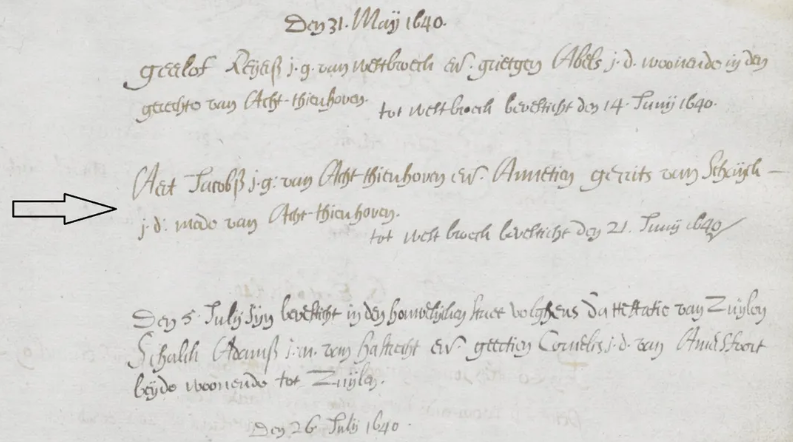
Original Dutch: Aert Jacobsz j.g. van Achthienhoven en Annitgen Gerrits van Schaijck j.d. mede van Achthienhoven tot Westbroeck bevesticht den 21 Junij 1640
English Translation: Aert Jacobsz, young unmarried man from Achtienhoven, and Annitgen Gerrits van Schaijck, young unmarried woman also from Achtienhoven, confirmed [married] at Westbroek on the 21st of June 1640.
Source: Regional Archives Northwest Utrecht in Breukelen (Netherlands), Church records marriages — Westbroek, archive 1200, inventory number 690, 21-06-1640, DTB N-H kerk Westbroek, deel 1, trouwregister, 1611–1751, folio 53.
The Patroonship Contract
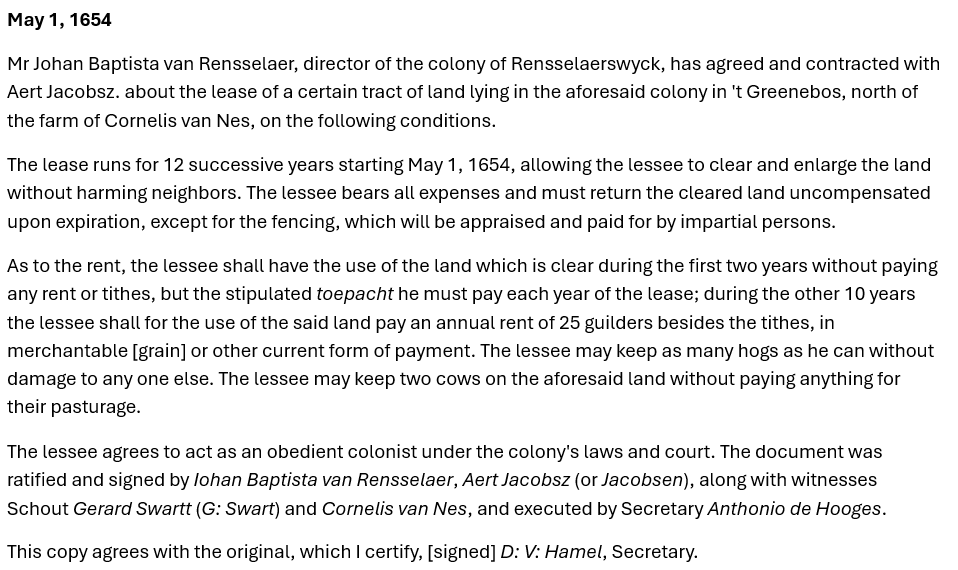
Upon arrival in New York, court records show Aert took a lease on a farm along the Vloman Kill (creek) in Bethlehem. In early 1654, official court minutes record a disaster: a catastrophic fire completely burned down his house, barns, and farming equipment. This is documented in the Van Rensselaer Bowier Manuscripts, available online. The 1654 contract with Jan Baptist van Rensselaer was for twelve long years — so how did he get out of it to buy farmland near Kingston?
The lease explicitly noted that at expiration, the tenant would not receive compensation for cleared land, "with the exception of the fence, for which he shall be paid or compensated according to an appraisal by impartial persons." Over his seven years on the farm (1654–1661), Aert spent extensive capital and heavy manual labor splitting logs and building extensive boundary fences to protect his fields. When he decided to relocate to Esopus, he requested an official appraisal of these improvements. The substantial value of his fencing was used as a credit to completely wipe out any remaining back-rent he owed to Director Jan Baptist van Rensselaer's estate — a win-win for both sides.
Aert's purchase contract stipulated that the 600 guilders would be paid "half in beaver and half in wheat at market prices." Having spent seven years running an active agricultural farm in Greenbush, his harvested wheat served as direct currency. Independent farmers also routinely traded with local indigenous populations or regional merchants to accumulate beaver pelts, which functioned as the standard high-value currency of the colony.
The Kingston Farm
Aert purchased approximately 99 acres of fertile land outside of Kingston, NY (then called Wiltwyck) in between the first and second Esopus Wars. After the first war, a stockade was built to protect residents; however, hostilities had ceased by 1660 and Aert chose to live outside the fortified area. Then the second Esopus War started, and his house was burned.
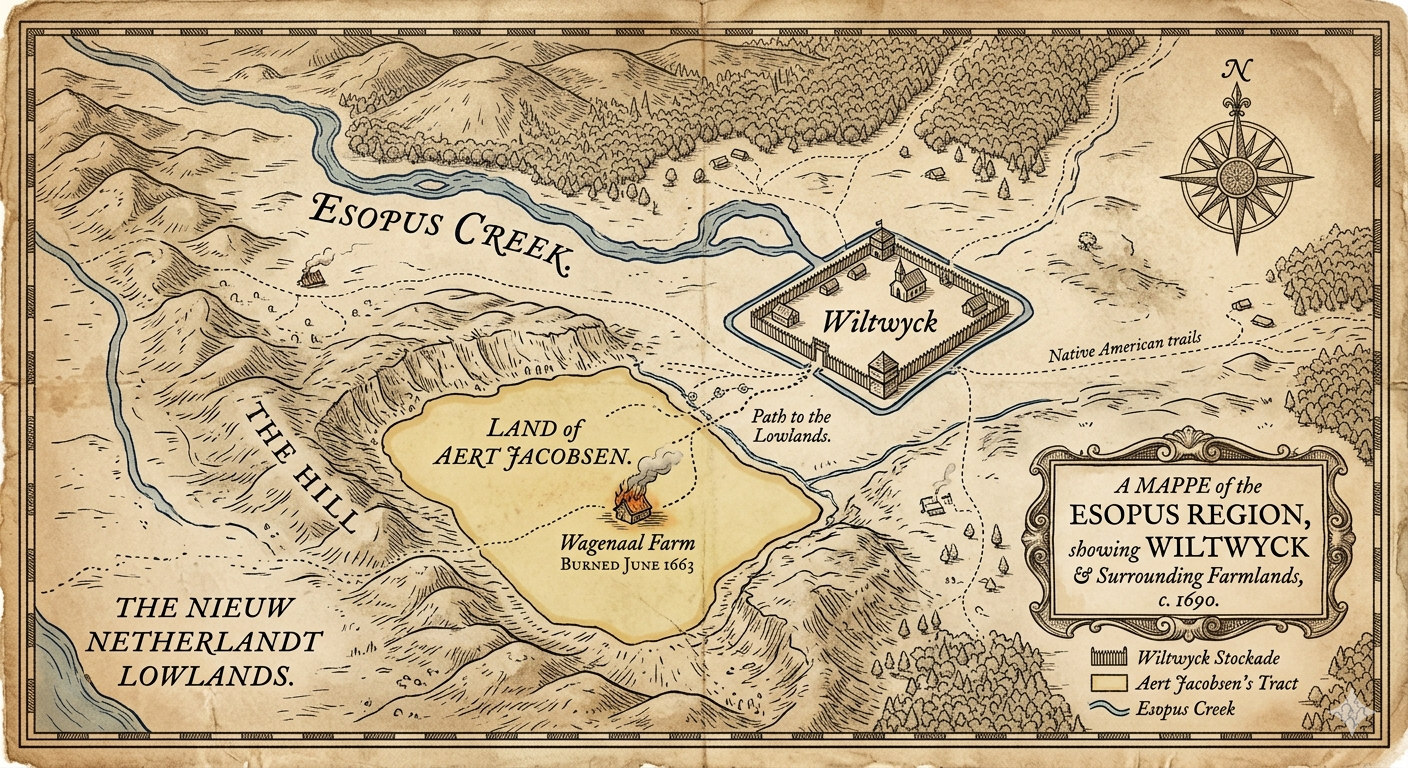
After Aert died around 1666 or 1667, his son Jacob Aertsen expanded his share of the property significantly, purchasing a massive 600-acre tract from Colonel Henry Beekman and incorporating his father's original boundaries. This newly consolidated estate along the Rondout Creek officially became known as Wagendaal — Dutch for "Wagon Valley." The area was included in the Corporation of Kingston until October 19, 1708, when it became part of the Town of Hurley. It continued to be known as Wagendaal until the Delaware & Hudson Canal opened in 1828, when it was renamed Creeklocks. On April 26, 1844, it became part of the Town of Rosendale.
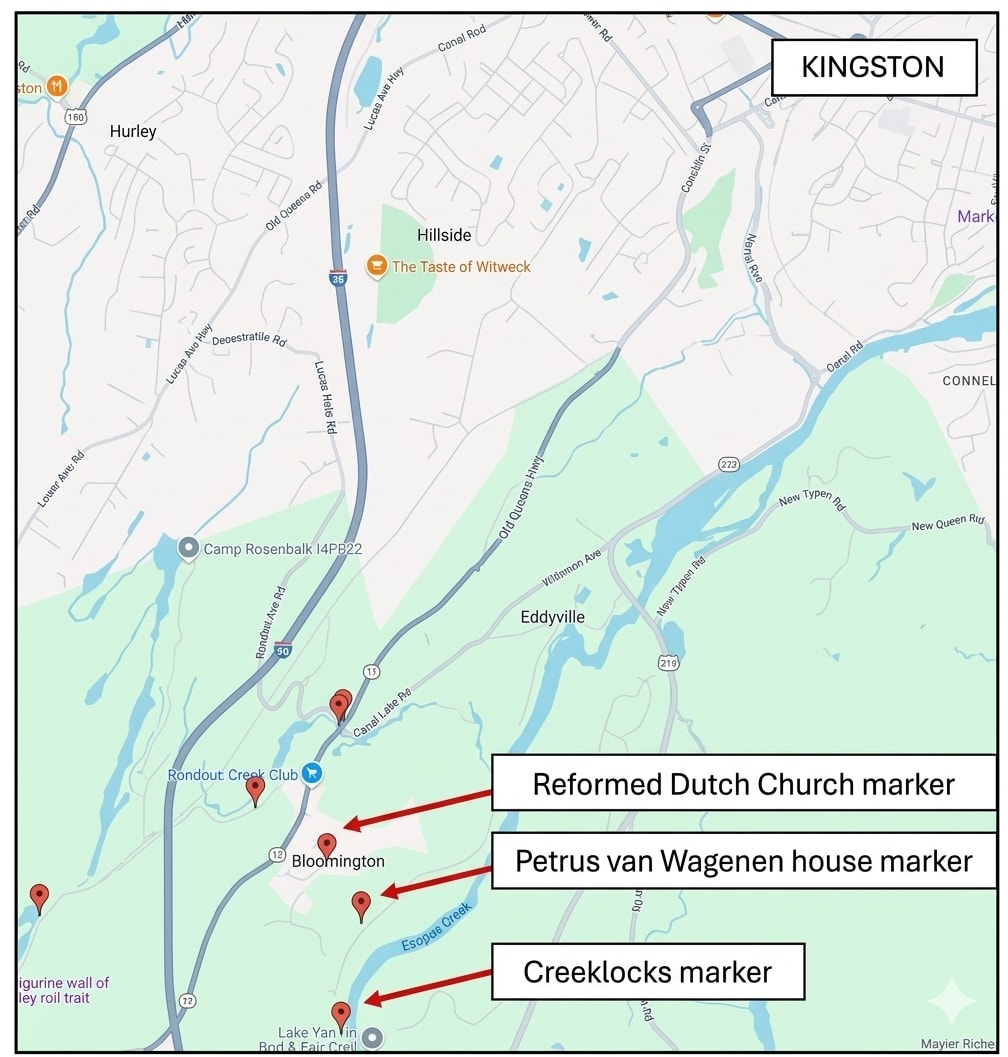
Aert's five children divided the land equally after his death. The core settlement (Wagendaal) sat right on the border of Kingston and the Town of Hurley — today this specific area is known as Creek Locks, an unincorporated hamlet in Ulster County, New York.
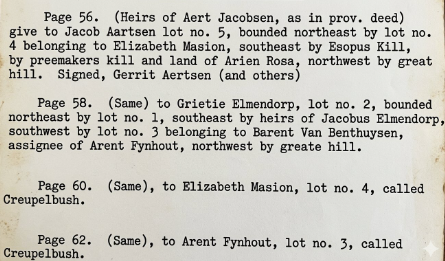
| Page | Recipient | What They Received |
|---|---|---|
| Page 54 | Gerrit Aartsen | Lot No. 1: Located on the "great piece" on the north side of Esopus Creek. |
| Page 56 | Jacob Aartsen | Lot No. 5: Bounded by Elizabeth Maston's land, Arion Rosa's land, a "great hill", and the Esopus Kill (Creek). |
| Page 58 | Grietie Elmendorp | Lot No. 2: Bounded by Lot No. 1, a "greate hill", and a lot belonging to Barrent Van Benthuizen. |
| Page 60 | Elizabeth Maston | Lot No. 4: A piece of land specifically called "Creupelbush" (historically meaning a swampy thicket or brushland). |
| Page 62 | Arent Fynhout | Lot No. 3: Another piece of land also called "Creupelbush". |
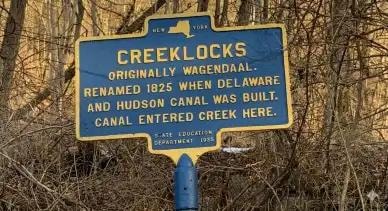
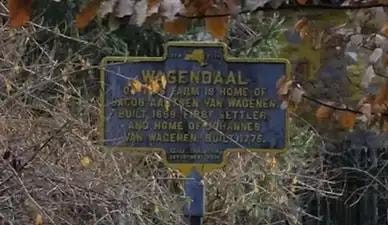
Creeklocks is an unincorporated hamlet located in the town of Rosendale in Ulster County, New York. The original name Wagendaal translates to "The Valley of the Van Wagenens." The name was given by early Dutch colonists, combining "Wagenen" (the family name) and "daal" (Dutch for "valley"). This land was obtained in a later generation and was not part of Aert's will.
The area used to be known as Wagendaal, which was included in the Corporation of Kingston until October 19, 1708 when it became part of the Town of Hurley. The community continued to be identified by that name until the upstart of the Delaware & Hudson Canal in 1828, when it was changed to Creeklocks. Then on April 26, 1844, it became part of the Town of Rosendale.
A Note on Jacob Aertsz
A few family histories claim that Jacob Aertsz — a man who came in 1637 on den Calmer Sleutel4 — was Aert Jacobson's father. According to the Dutch naming system, we can surmise that Aert's father was indeed named Jacob. However, the dates don't entirely line up with a father-son relationship, so either this was a brother or the two men are completely unrelated. This person "Jacob Aertsz" was also referred to as "Jacob Aertsz Wagenaer," and it's possible that future generations made incorrect assumptions about the relationship.
Footnotes
- 1 There is some confusion as to where the family came from in their own records. Aert said he was from Achtienhoven, as did his daughter Neeltje on her marriage record. Another daughter, Grietje, stated the family was from Vytrecht. Later, Aert's grandchildren started referencing Wageningen. These places are 25–30 miles from each other.
- 2 Regional Archives Northwest Utrecht in Breukelen (Netherlands), Church records marriages — Westbroek, archive 1200, inventory number 690, 21-06-1640, DTB N-H kerk Westbroek, deel 1, trouwregister, 1611–1751, folio 53.
- 3 The Colonial Ancestry of the Family of John Greene Briggs; Author: Briggs, Harry Tallmadge.
- 4 https://albany.nygenweb.net/settlers.htm