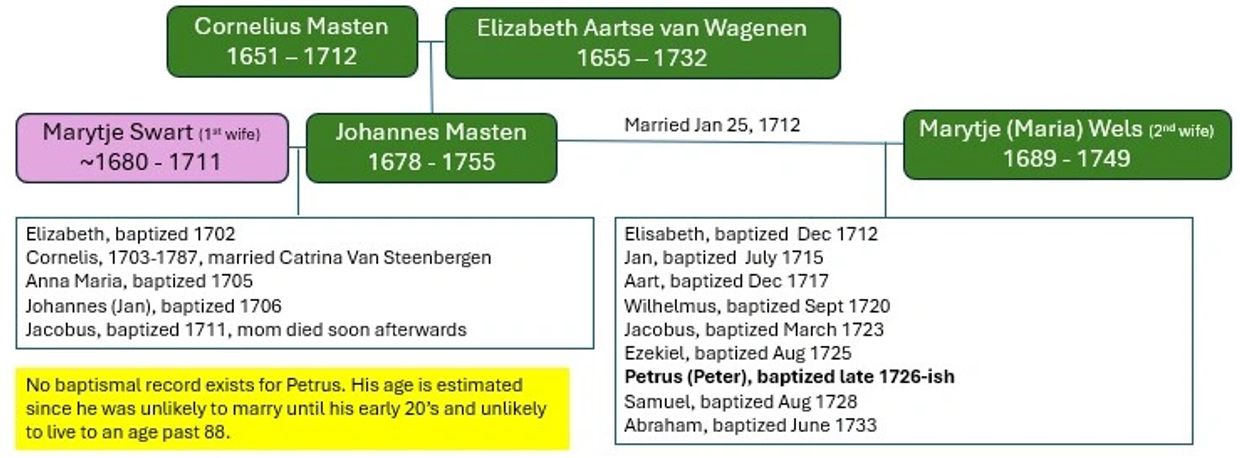
Johannes entered the world in 1678 soon after his parents Cornelis and Elizabeth were married, and in true Dutch naming fashion, he received his grandfather's first name (well, the "dutchized" version of John).
Living in the historic Dutch enclave of Kingston, New York, Johannes Masten was the definition of an industrious family man. His first marriage to Marytje Swart in 1701 brought five children into the world. Sadly, Marytje passed away in 1711 shortly after giving birth to their youngest son, Jacobus.
Johannes did not remain a bachelor for long - most eighteenth century men with five youngsters needed a replacement wife ASAP. In January 1712, he married his second wife, Marytje (Maria) Wels, and together they spent the next two decades dramatically expanding the family tree. Nine more children followed!
Among this second batch of children was a son named Petrus (Peter). Petrus was a bit of an enigma—he completely missed his scheduled date with the baptismal font, leaving us to guess his birth as a "late 1726-ish" arrival and a few people thinking he actually came from Ireland (!!). Despite his lack of official paperwork, Petrus grew up, thrived, and passed down the family line to become a direct ancestor of Herman L. Wolf.
Johannes passed away in 1755 at the ripe old age of 76 without a will. It is because of this what we had to go through a pile of documents to prove via VERY STRONG circumstantial evidence that he had a son named Petrus, who was the progenator of the Fayette County PA Masten line.


The stone house, originally built by Herman Wolf’s 3th great-granduncle Cornelis (son of Johannes and his wife Marytje Swart), eventually came into use by the community and is historically known today as the Old Dutch Church Parsonage. A full filing of the Historic Places paperwork can be found at this link: https://catalog.archives.gov/medialz/electronic-records/rg-079/NPS_NY/01000845.pdf (very slow to load)
NOTE: This is NOT built on the same plot where his grandparents Cornelis and Elizabeth lived. The OG Cornelis lived in an early timber-and-stone dwelling inside the stockade gates. His home, and his barn, stood on a different plot entirely—at the corner of what is now John Street and Fair Street. Later on, they began expanding their property holdings south of the stockade.
The non-elected, universally hated governor Peter Stuyvesant ordered the wood stockade built in 1658, and settlers were strictly forbidden from living outside it due to the Esopus Wars. Under English Governor Francis Lovelace, living outside the stockade transitioned from "tolerated" to explicitly authorized and encouraged in ~1669.
Copyright © 2026 Book of Ruth and Chuck - All Rights Reserved.
We use cookies to analyze website traffic and optimize your website experience. By accepting our use of cookies, your data will be aggregated with all other user data.
