
Petrus entered the world sometime around 1725–1728, the son of Johannes Masten and his second wife Marytje (Maria) Wels. He grew up in Kingston, New York, learned the skilled trade of coopering (barrel-making), married twice, fathered at least ten children, fled crushing debts across a provincial border, and lived to be nearly ninety years old in Fayette County, Pennsylvania. He is the direct ancestor of Herman L. Wolf.
Proving Peter's Lineage
To establish the parentage of Petrus Masten, we must look to the regional progenitor, Cornelius Masten. Genealogical evidence indicates that Cornelius was the only individual of that surname residing in the area during this period. Furthermore, his last will and testament restricts his male heirs to just two named sons: Johannis and Aert. By a strict process of elimination—given the complete absence of any alternative Masten families in the regional record—Petrus must be the biological son of either Johannis or Aert because his five children (including daughters Dievertje, Antie and Geertjie) are explicitly named in the will.
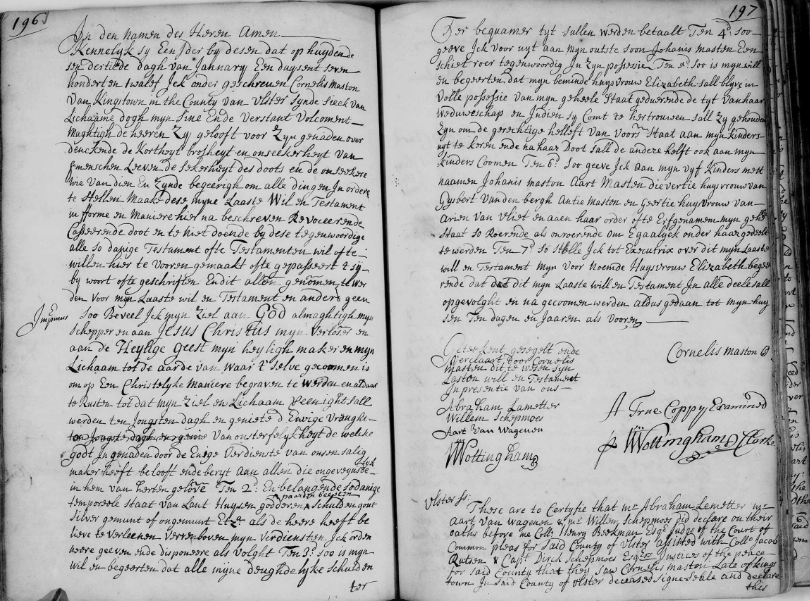
It would have been nice if Johannes or Aert left a will for us to find out who all of their living sons were when they died, but alas, either they did not or the will was lost to time.
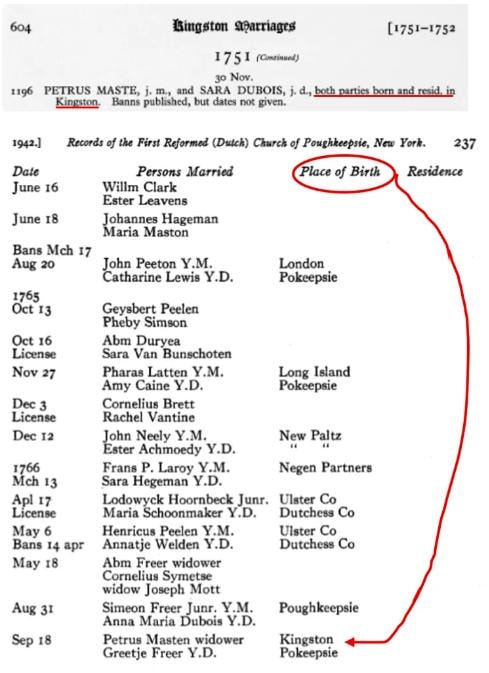
Petrus married twice; following the death of his first wife, Sarah Dubois, he wed Greetje Freer.
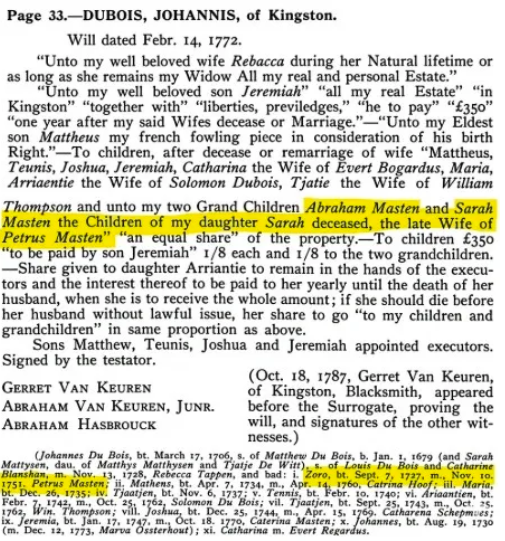
Johannis Dubois, in his will, tells us that his daughter Sarah was married to Petrus Masten and they two children from that marriage (Abraham and Sarah) that were both alive at the time the will was written in 1772.
We know Petrus was born in Kingston NY from his marriage records
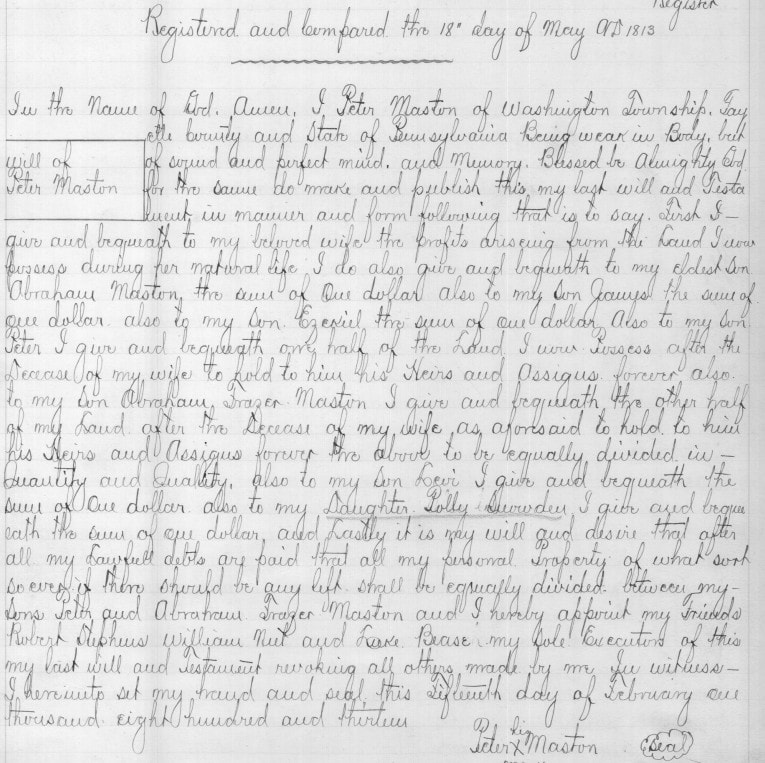
The best markers of when Petrus was born are the date of his first wedding and the date of his death (because he lived to be an old man!) He initially was a cooper (barrelmaker) by trade, which is a skill that required 5–7 years of apprenticeship before breaking out on your own. He was also unlikely to marry before he could support a family, so that probably means he was at least 23 when he married in 1751. If he reached age 90 when he died in 1813, that puts his likely birth year between 1723 and 1728. His will is shown below.
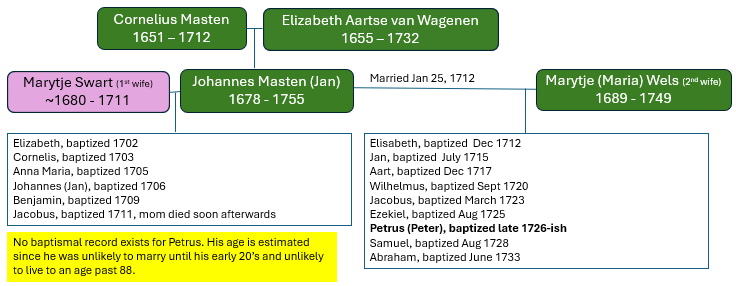
Property records provide additional proof that Petrus was the son of Johannes, not Aert. Because early Dutch records frequently interchanged formal names with common variants, both Johannes and Jan are used.
The first document describes a land sale between Johannes (the father) and Johannes (the son). This is notable because the land is described in terms of two of Jan Jr's brothers: Ezekiel and Benjamin. Petrus is not mentioned in the transaction. The document itself is long - you can read the whole thing in NY Land Records, Ulster Co Deeds 1722-1757, Liber EE Page 372 (document starts at bottom of page). Best I can tell, the 5.9 acre property Jan Jr bought from his father is outside of the stockade on the NW side. Ezekiel’s lot was to the west of Jan Jr, and Benjamin’s lot was to the east.
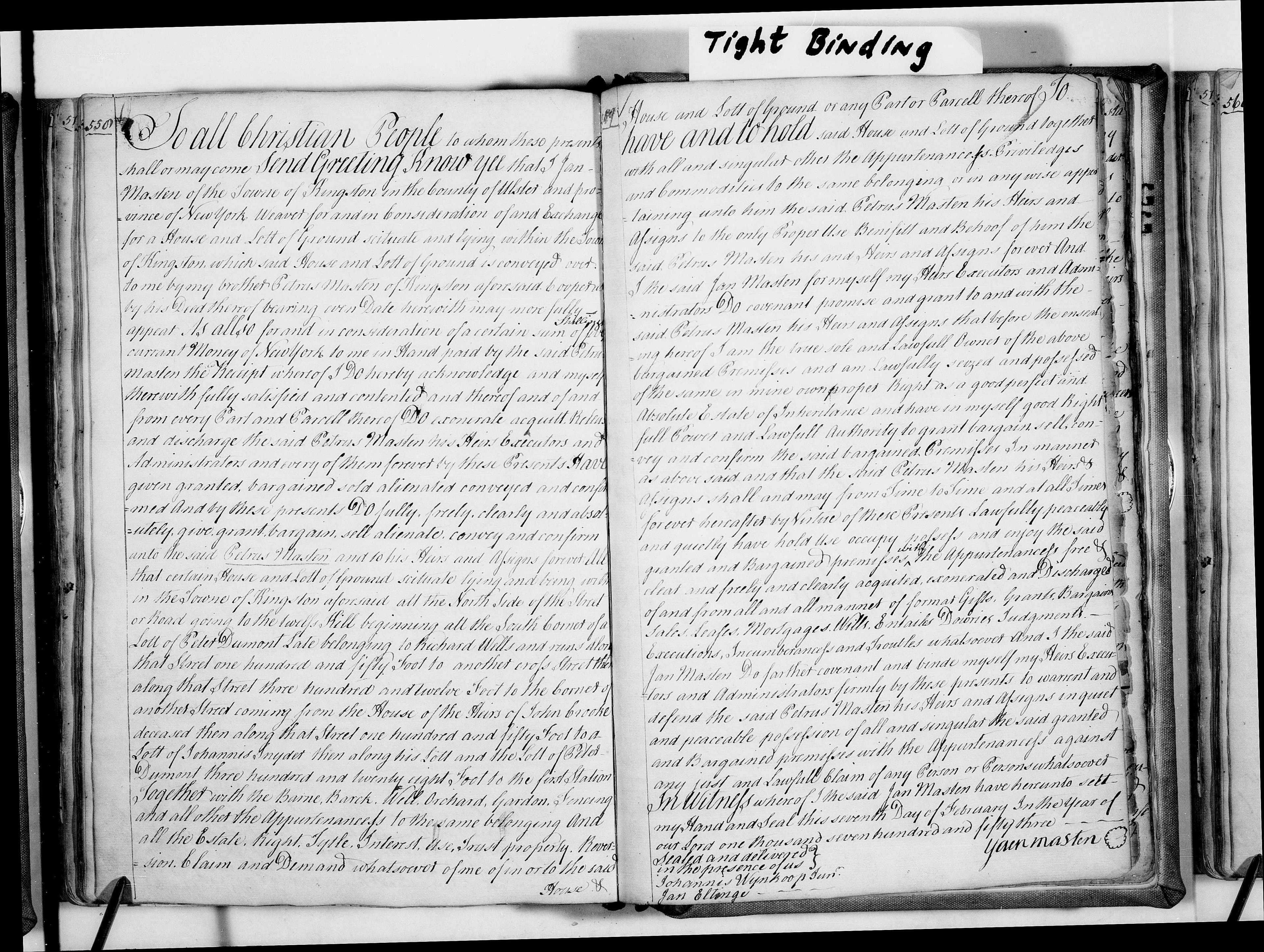
The verbiage of second transaction states it was between Jan Masten (identified as a weaver from the "Towne of Kingston in the County of Ulster and province of New York") and Petrus Masten - and it explicitly says these individuals are BROTHERS. This is proof that Petrus has a brother named Jan and both lived in Kingston in 1753. You can find this document online, Liber GG, p 558. These are two separate lots but they are very close in proximity to each other – no more than a mile or two.
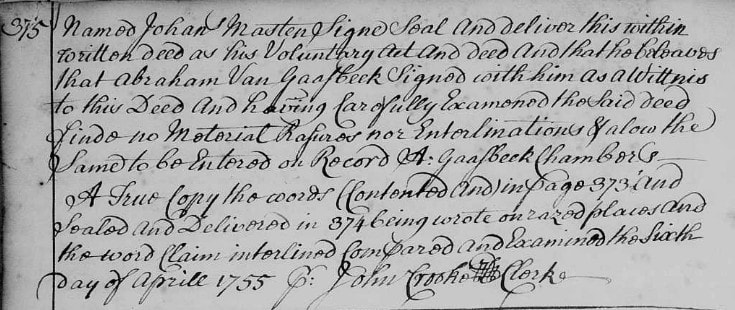
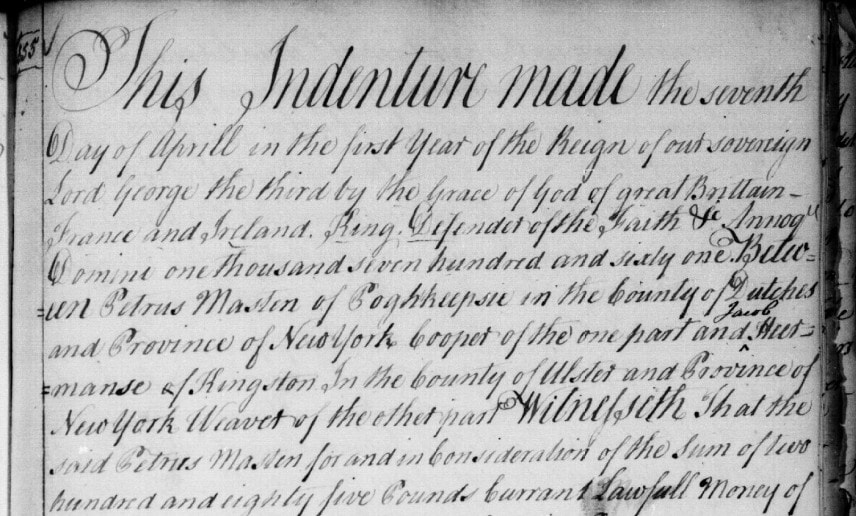
But wait, there is more! In this 1761 document, Petrus sells the exact same "twelys Mill" property he swapped with Jan Jr in 1753 to Jacob Heermance. Petrus is living in Poughkeepsie at the time of this transaction. Notably, Heermance is a Weaver—meaning this specific town lot (with its house and barn) continued to be used for the exact same textile trade that Petrus's brother, Jan Masten, practiced there in the 1740s and 1750s. You can also access this online if you want to read the whole thing - Liber GG, p. 555.
Peter's children from first marriage
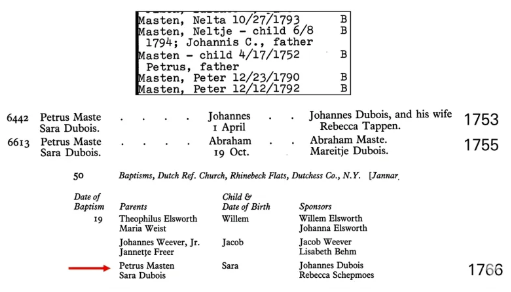
First child died — buried in Kingston 1752. He/she was not named but is in the burial records.
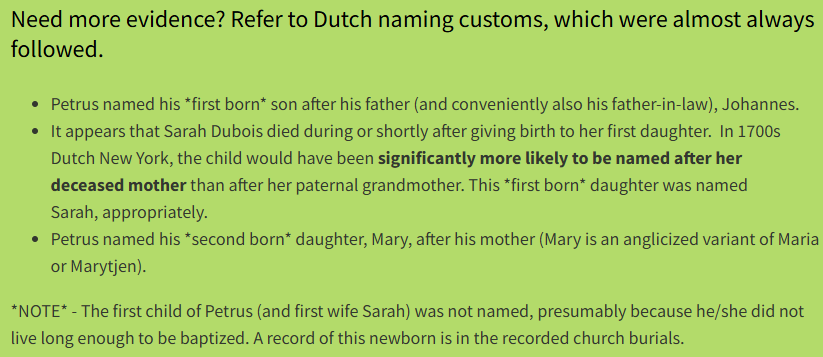
The second child was baptized in Kingston in 1753. Named Johannes, after Petrus' father (using conventional Dutch naming system), he died young. He was not mentioned in Johannes DuBois' will in 1772.
The third child was Abraham, baptized in Kingston in 1755; we know he outlived his father and received proceeds from his will.
The last child with wife Sarah was a daughter named Sarah who was baptized in Poughkeepsie in 1766. She was still alive when Johannes Dubois wrote his 1772 will, but was not living with her father in Fayette Co PA in 1790 and probably did not reach adulthood.
Peter's children from second marriage
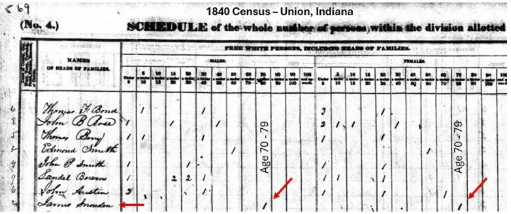
Mary, called Polly, was the first child to be born to Petrus and Grietje Freer. She was likely born in Poughkeepsie although no record can be found for her baptism (from late 1767 through late 1769 many, many baptisms went unrecorded).
She went to Fayette County and as an adult, married James Snowden. The 1840 census was her last, and it shows she was between 70–79 years of age, which put her birth year between 1761–1770. The fact that she was born after Petrus married Grietje puts it after early 1767, and we need to allot some time for her brother James to be born as well (according to the 1850 census, he was born about 1769). So to sum it up, she was born around 1767 or early 1768 in Poughkeepsie.
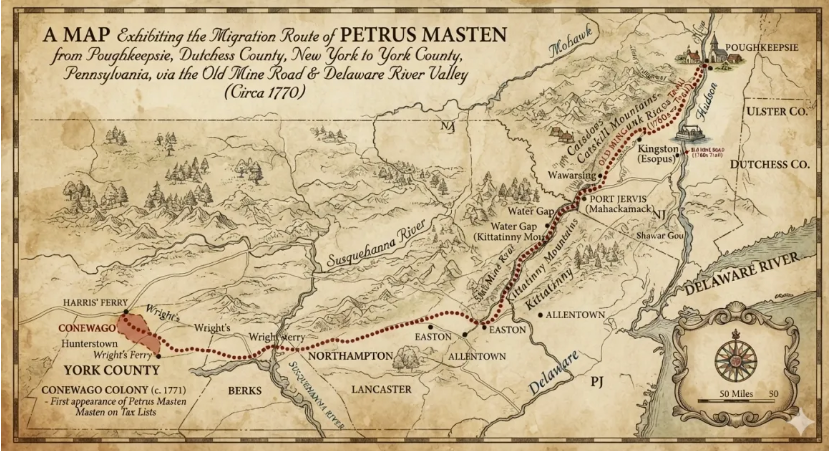
James was the first known male child to be born to Petrus and Grietje Freer. James ended up moving to Tuscarawas, Ohio as a farmer. He appears on the 1850 census as being born about 1769 in Delaware. I think this more likely means he was born along the Delaware River since that is how Petrus and Grietje most likely would have travelled during their move between Poughkeepsie and York Co PA. It's either that or haul your horses, wagon, screaming children and all your earthly possessions over the mountain range.
Depending on the trip timing, it is possible they may have stopped somewhere to rest or let the weather become more favorable, so it is entirely possible that James may have been born enroute.
Children
First Marriage — Sarah Dubois (1751)
Johannes Dubois, in his 1772 will, records that his daughter Sarah (aka Zara) was married to Petrus Masten prior to her death, and that they had two living children: Sarah and Abraham. The footnotes establish the marriage date as November 10, 1751. Sarah Dubois appears to have died during or shortly after the birth of their first daughter.
- Unnamed infant~1752died before baptism; burial recorded in Kingston
- Johannesbaptized Kingston, 1753named after Petrus's father; died young, not in Dubois 1772 will
- Abrahambaptized Kingston, 1755outlived his father; received proceeds from Petrus's will
- Sarahbaptized Poughkeepsie, 1766alive in 1772 per Dubois will; likely did not survive to adulthood
Second Marriage — Grietje Freer (~1767)
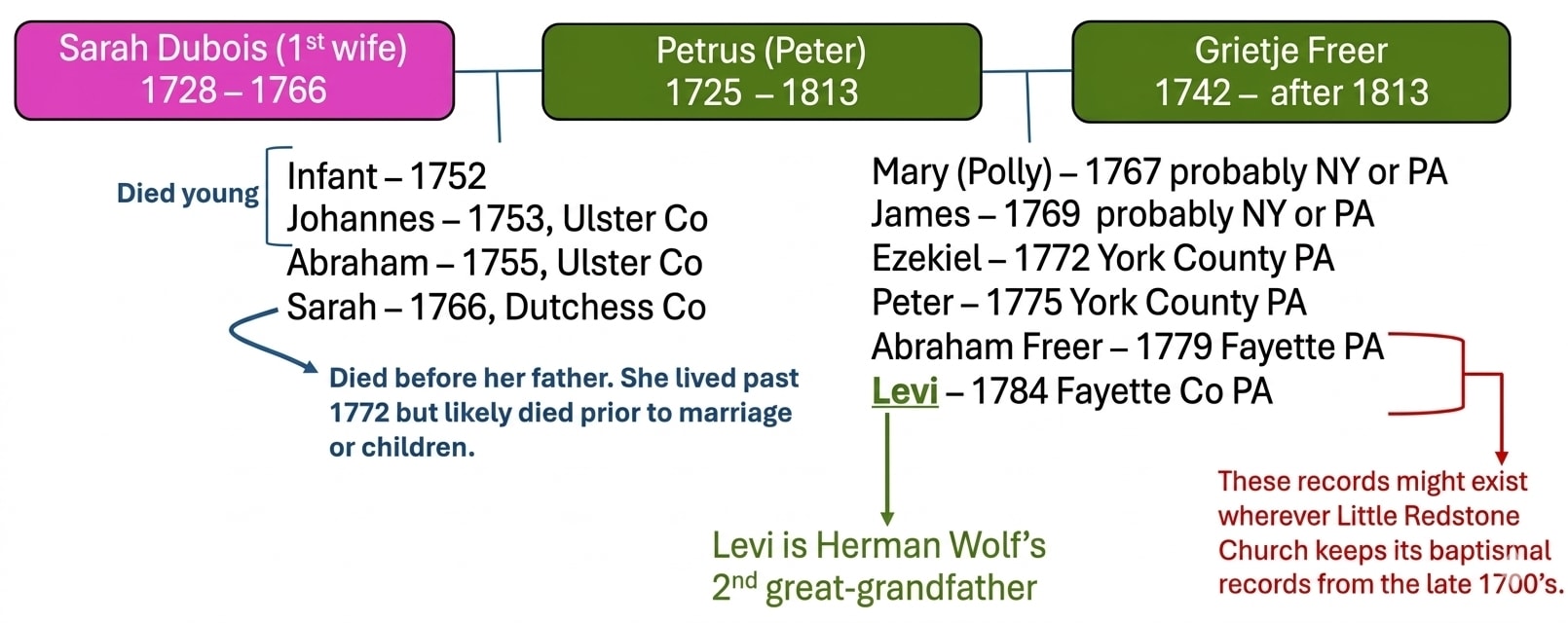
After Sarah Dubois's death, Petrus married Grietje Freer. Together they had six more children, most born during the family's migration from Poughkeepsie through York County, Pennsylvania, and eventually to Fayette County.
- Mary (Polly)~1767–1768, Poughkeepsiemarried James Snowden; last appears on 1840 census aged 70–79
- James~1769, born en route along the Delaware Rivermoved to Tuscarawas, Ohio; appears on 1850 census
- Ezekiel~1772, York County PAborn in the Low Dutch Conewago settlement
- Petrus Jr.~1775, York County PAborn in the Low Dutch Conewago settlement
- Abraham Freer~1779, Fayette County PAmiddle name honors mother's maiden name Freer; laborer in Coshocton, OH
- LeviFayette County PAmentioned in Petrus's will
The Cooper of Kingston
While in New York, Petrus made his living making barrels — a highly skilled trade requiring up to seven years of apprenticeship. Legal documents from the period list his profession as cooper. It was a good income when business was flowing, but it left him dangerously exposed when his credit network collapsed.
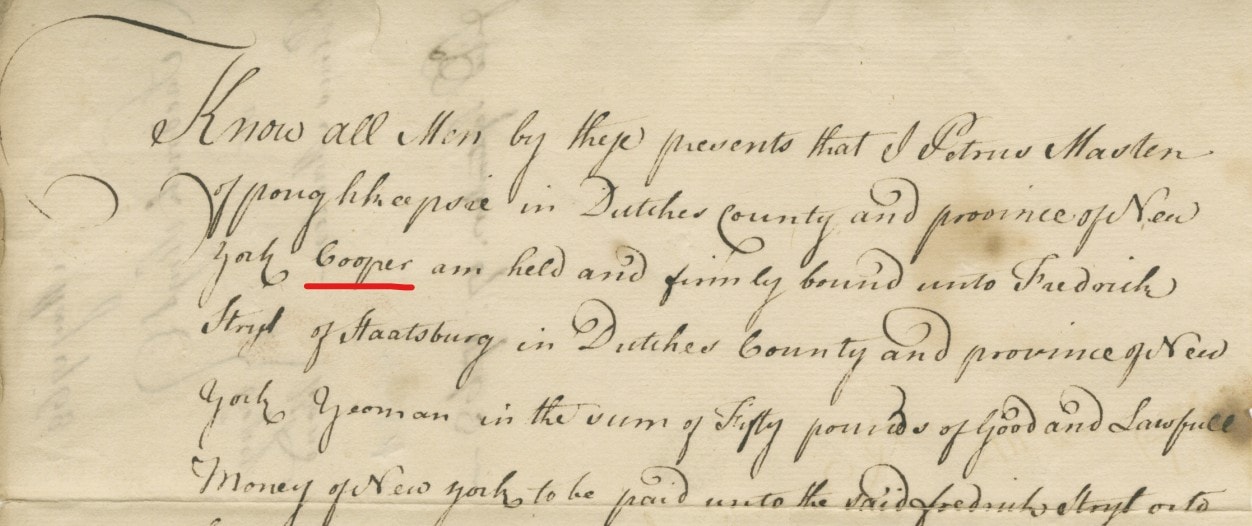
Why Petrus Left New York
In the 1760s, business ran on barter, trade tabs, and chain-of-debt assignments. Petrus was asset-rich and cash-poor — and when his debtors stopped paying him, his entire credit structure came apart.
Moving from New York to Pennsylvania offered immediate relief — a Dutchess County Sheriff had zero jurisdiction inside Pennsylvania's borders. For a man being hunted by New York creditors, slipping away to a remote, tightly knit frontier Dutch community was the ultimate strategy to avoid debtor's prison and restart his life.
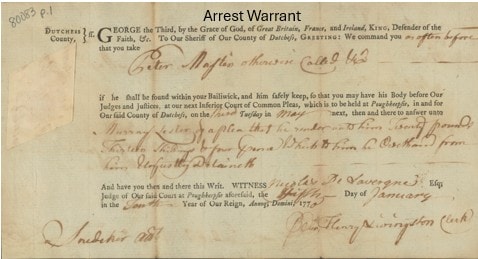
Legal documents can be found in the Dutchess County Ancient Documents archive (search "Mastin" and "Masten").
The Low Dutch Settlement of the Conewago
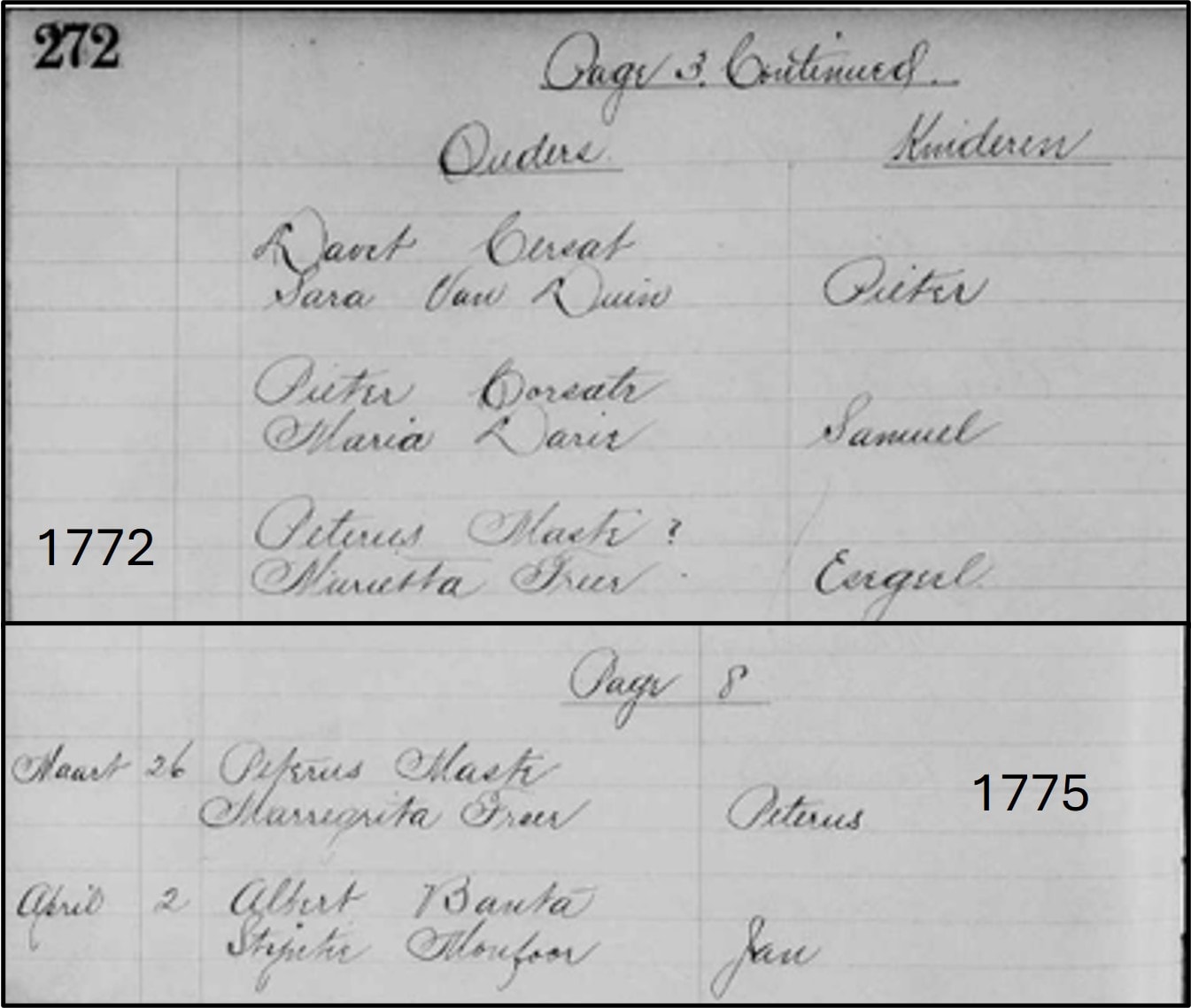
In the early 1760s, many Low Dutch families had relocated to York County, Pennsylvania, hoping to preserve their language, customs, and Dutch Reformed Church traditions. By the time Petrus and Grietje arrived, the Dutch had formed their own "Conewago" congregation and built a central "Low Dutch Road" to connect their sprawling farms. Sons Ezekiel and Petrus Jr. were born here around 1772 and 1775.
Petrus and the Revolutionary War
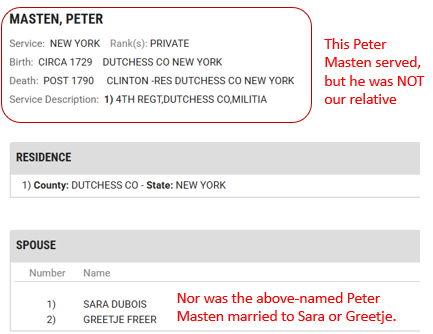
The DAR record for a Peter Masten IS NOT the one who moved to Pennsylvania. Our Petrus left New York around 1770 and was in York County PA when the war broke out. He was not going to return to New York with a wife and young children, especially with active arrest warrants likely still outstanding. There are no records of him in the Continental Army, and at 50–55 years old, none would be expected. Pennsylvania's wartime "Association" policy required able-bodied men to join local defense units; those who did not were labeled Non-Associators and taxed heavily. However, Petrus does not appear in the Pennsylvania Archives, Third Series, Volume 21 — the property and estate tax assessments used to fund the war. He arrived in Westmoreland County (later Fayette) by 1783, with a tax list note reading "F. State Omitted," meaning he received tax amnesty as a frontier settler who owned no land.
Settling in Fayette County
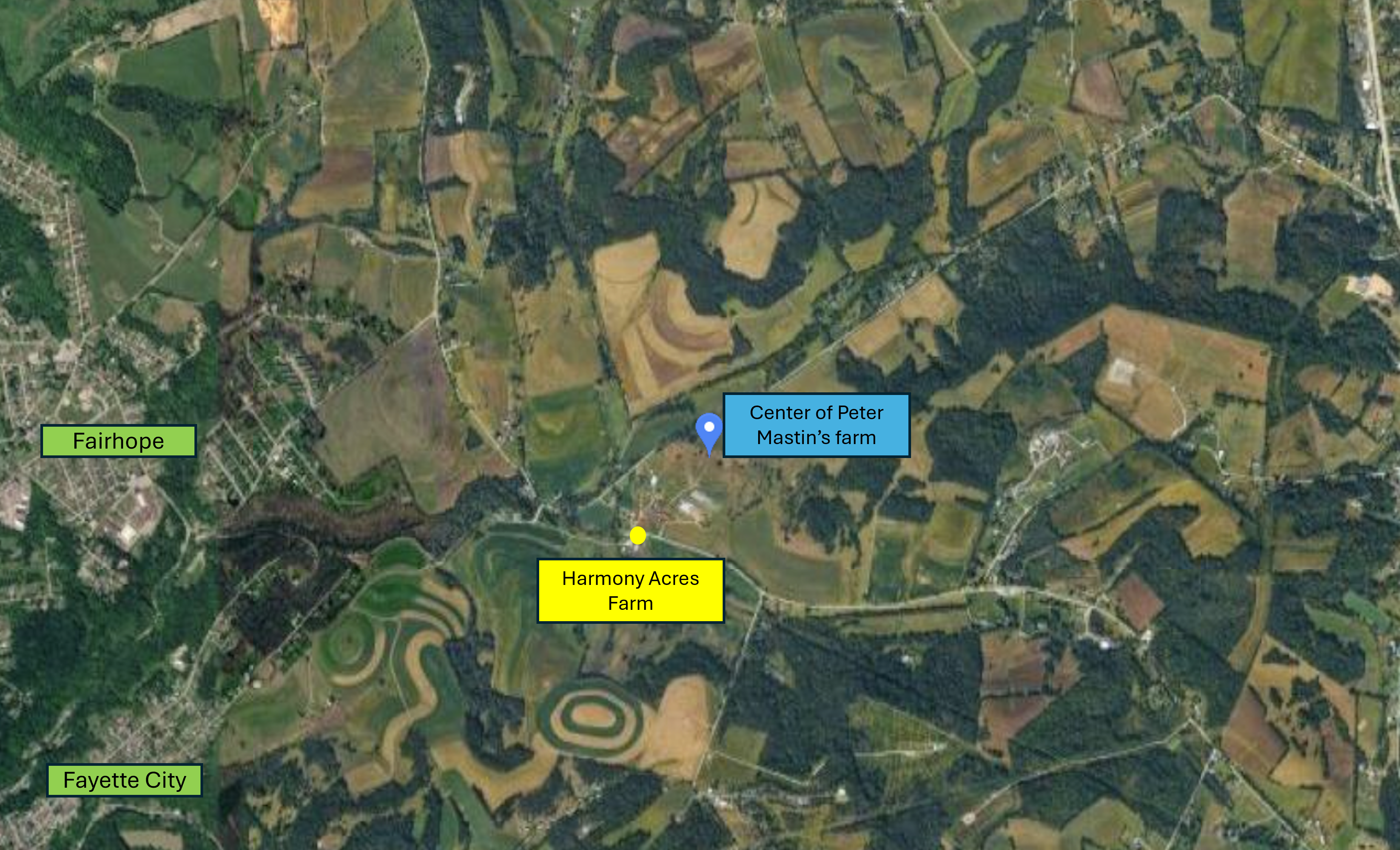
Peter (he had dropped the Dutch "Petrus" by this point) purchased 117 acres in Fayette County, Pennsylvania. His land warrant was issued by the Commonwealth of Pennsylvania in 1791. Much of that land is today encompassed by Harmony Acres farm.
Building a Church
Little Redstone United Methodist Church, located in Fayette City, was built in 1857 and its roots tie back to Peter Masten. Before acquiring that permanent location, the congregation did not have its own dedicated building and instead held meetings in private residences (including the homes of Peter Masten, Nathaniel Stephens, Robert Stephens, and Hugh Ford) from 1784 until 1817, after which they transitioned to the neighboring log church.
Prior to the construction of the permanent brick structure in 1857, early members of what became the Little Redstone United Methodist Church were buried in the adjacent burial grounds that surrounded the Old Baptist Log Church.
The cemetery surrounding the modern church originated as the burial grounds for the Old Baptist Log Church, which the Methodist congregation began utilizing around 1817. Because Peter Masten died in 1813—just a few years before the formal shared transition to that property—his grave may have been among the many early, unmarked pioneer plots whose wooden markers or fieldstones eroded over the centuries.
While Peter’s marker is missing, his son and Herman’s ancestor, Levi Masten (1784–1867), and daughter-in-law, Sarah Stephens Masten (who married in 1801), are both formally documented and buried in the Little Redstone Methodist Episcopal Church Cemetery. Because his children and extended family are buried there, it remains highly probable that Peter was laid to rest on the same grounds or on his nearby family homestead.
Peter's death and legacy
Petrus died in 1813 at approximately 88–90 years of age. His will (Fayette County, Book 1, page 301) names his wife as still living, and lists his surviving children: oldest son Abraham, and sons James, Ezekiel, Peter, Levi, and Abraham Frasier (a loose rendering of Abraham Freer, honoring his mother's maiden name). His daughter Polly Snowden is also named. His daughter Sarah, born to his first wife Sarah Dubois, is absent — she was alive in 1772 but likely did not survive to adulthood.
Further Reading
- Anjou, Gustave. Ulster County, N.Y., Probate Records. Ulster County Clerk's Office, 1906
- NY Land Records, Ulster Co Deeds 1722–1757, Liber EE Page 372 (Jan Jr. buys land from Jan Sr., July 1752).
- NY Land Records, Liber GG, p. 558 (Johannes and Petrus swap property, February 1753).
- NY Land Records, Liber GG, p. 555 (Petrus sells to Jacob Heermance, 1761).
- Dutchess County ancient documents: https://apps.dutchessny.gov/public-access-viewer/AncientDocuments (search "Mastin" and "Masten").
- Fayette County Wills, Book 1, page 301 (will of Peter Masten, 1813).
- Pennsylvania Archives, Third Series, Volume 21 (Revolutionary War tax assessments).