Petrus Masten (~1725 - 1813)

Proving Peter's Linage (aka, who were his parents?)
Start with his other siblings

This is his brother Ezekiel's will, transcribed from the original written will. In the probate records from Ulster County that were compiled in 1906, they usually put in notes as to who his family was (below green line). And you will see, Peter (aka Petrus) is missing. Ideally we would LOVE to have Johannes Masten's will (Peter and Ezekiel's father) but that will could not be located. It was either destroyed or he died without a will.
Children of Johannes Masten
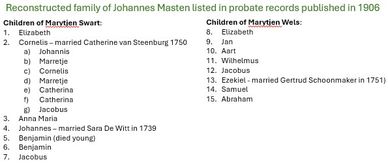
The dude who compiled these Kingston Probate records, Gustav Anjou, did use the church records to make these notes. But, he was also being paid by wealthy clients to reconstruct prestigious family trees and was later found to liberally use things like an invented child, marriage, or an entirely hypothetical generation to explain gaps in the tree or timeline. There are several articles about his shenanigans in several
reputable magazines, including the National Genealogical Society. So these notes at the end of the transcribed will are not foolproof, might contain people that don't exist, and should be used with extreme caution. In our case, Anjou was using baptismal records and we have already established that Petrus does not have any records in the Kingston area. Perhaps they burned when the Brits torched the town in 1777?
We know Petrus married, twice

Johannis Dubois, in his 1772 will, tells us that his daughter Sarah (aka Zara) was married to Petrus Masten prior to her death and they had two living children: Sarah and Abraham. The footnotes show that Petrus and Sarah married on Nov 10, 1751. Even though I told you not to trust the Anjou footnotes, we do have backup for this statement. It DOES establish some justification for Petrus Masten's birthdate, since in those days a first marriage for a man occurred about the time they could provide for themselves and a family (usually in the mid-20's).
What about Aert Masten?

You may be wondering how I know that Petrus belonged to Johannes and not Aert or someone else. First off, Cornelis was the progenator of the Masten family in the Kingston/Poughkeepsie area and he died prior to Petrus' birth, so Petrus must be his GRANDSON. That leaves only Johannes and Aert, his only two sons, as possibilities.
This question will be definitively answered further down, but now, let's trace Petrus' steps between PA and NY and build out his family tree to provide strong circumstantial evidence of his parentage.
Aart Masten's will names his kids
Aart Masten's will names his kids

Summary : He leaves everything to his wife Elizabeth for the duration of her widowhood. If she remarries, she will relinquish half of the estate to the children. Then, upon her death or full distribution, his entire estate is to be divided equally among his five children, who are explicitly named: Johannis, Aert, Dievertje, Antie and Geertjie. It would be highly unlikely for a son (specifically one named Petrus) not to be mentioned in a will.
Establishing Peter's birthplace
Aart Masten's will names his kids

Kingston. We know this because of the marriage records (both of them).
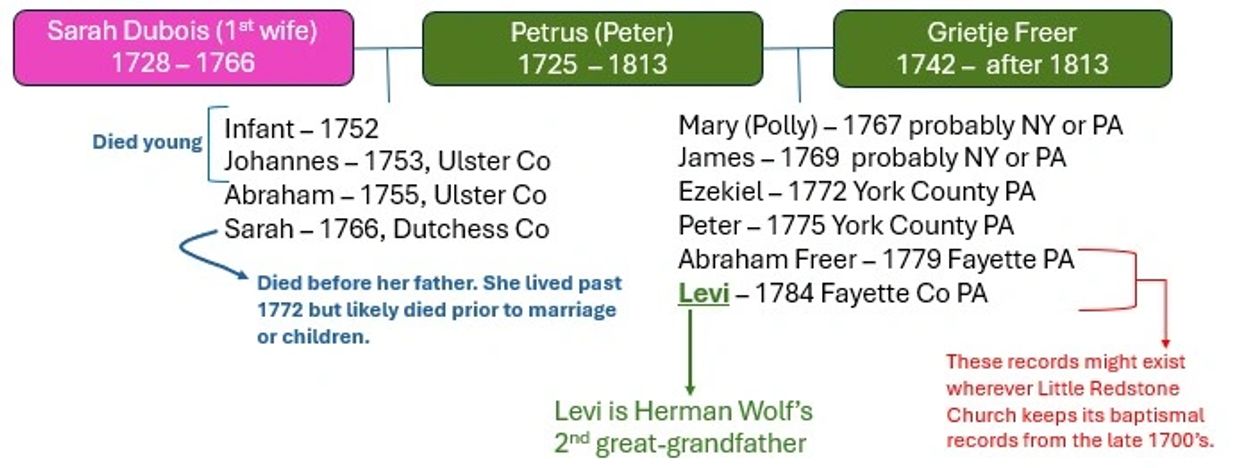
Children from his 1st marriage
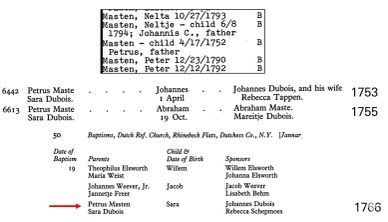
First child died - buried in Kingston 1752.
The second child was baptized in Kingston in 1753. Named Johannes, after Petrus’ father (using conventional Dutch naming system), he died young. He was not mentioned in Johannes DuBois’ will in 1772.
The third child was Abraham, baptized in Kingston in 1755; we know he outlived his father and received proceeds from his will.
The last child with wife Sarah was a daughter named Sarah who was baptized in Poughkeepsie in 1766. She was still alive when Johannes Dubois wrote his 1772 will, but was not living with her father in Fayette Co PA in 1790 and probably did not reach adulthood.
Children from his 2nd marriage

Mary, called Polly, was the first child to be born to Petrus and Grietje Freer. She was likely born in Poughkeepsie although no record can be found for her baptism (from late 1767 through late 1769 many, many baptisms went unrecorded).
She went to Fayette County and as an adult, married James Snowden. The 1840 census was her last, and it shows she was between 70-79 years of age, which put her birth year between 1761 - 1770. The fact that she was born after Petrus married Grietje puts it after early 1767, and we need to allot some time for her brother James to be born as well (according to the 1850 census, he was born about 1769). So to sum it up, she was born around 1767 or early 1768 in Poughkeepsie.
Children from his 2nd marriage
Children from his 2nd marriage

James was the first known male child to be born to Petrus and Grietje Freer. James ended up moving to Tuscarawas, Ohio as a farmer. He appears on the 1850 census as being born about 1769 in Delaware. I think this more likely means he was born along the Delaware [River] since that is how Petrus and Grietje most likely would have travelled during their move between Poughkeepsie and York Co PA. It's either that or haul your horses, wagon, screaming children and all your earthly possessions over the mountain range
Depending on the trip timing, it is possible they may have stopped somewhere to rest or let the weather become more favorable, so it is entirely possible that James may have been born enroute.
Children from his 2nd marriage
Children from his 2nd marriage

The Low Dutch were deeply committed to their language, customs, and the Dutch Reformed Church. In the early 1760’s, many had relocated to York County PA in hopes of forming tight-knit community that allowed them to preserve their identity. By the time Petrus and Grietje arrived, the Dutch had successfully formed their own "Conewago" congregation and built a central "Low Dutch Road" to connect their sprawling farms.
Sons Ezekiel and Petrus Jr were born here in 1772 and 1775. Note the spelling of Ezekiel is one of the common Dutch variations that use the letter “g” – (Ezegiel, Ezegiel and Ezeghiel).
Children from his second marriage

Peter, having ditched his Dutch name of Petrus, and his wife Grietje, had two more children, both born in Fayette County PA. The first was Abraham Freer, who was given a middle name to both distinguish him from his older brother Abraham (Sarah Dubois' child), and also as a nod to his mother's maiden name of Freer. He was born around 1779 according to the 1850 census. At that time, he was a laborer living in Coshocton, OH with six young children and his second wife Mary (also called Polly).
His first wife was Elizabeth "Betsey" Miller who died likely between 1836 - 1839. Abraham and Betsey had six children of their own, with the youngest being born around 1824.
Now figure out his birth year

The best markers of when Petrus was born are the date of his first wedding and the date of his death (because he lived to be an old man!) He initially was a cooper (barrelmaker) by trade, which is a skill that required 5 - 7 years of apprenticeship before breaking out on your own. He was also unlikely to marry before he could support a family, so that probably means he was at least 23 when he married in 1751. If he reached age 90 when he died in 1813, puts his likely birth year between 1723 and 1728. As a side note, it was VERY common, perhaps necessary, for a new widower with young children, especially a newborn, to quickly marry again, just like Petrus did when his 1st wife died.
More info to put the pieces together
Peter was a COOPER before leaving NY

While in New York, Petrus made a living making barrels. This was a highly skilled job and generally provided a good income, although it took up to seven years as an apprentice to become one.
Legal documents such as this one list his profession.
Jan Jr buys land from Jan Sr (July 1752)

This is notable because the land is described in terms of two of Jan Jr's brothers: Ezekiel and Benjamin. Petrus is not mentioned in the transaction. The document itself is long - you can read the whole thing in NY Land Records, Ulster Co Deeds 1722-1757, Liber EE Page 372 (document starts at bottom of page). Best I can tell, the 5.9 acre property Jan Jr bought from his father is outside of the stockade on the NW side. Ezekiel’s lot was to the west of Jan Jr, and Benjamin’s lot was to the east.
Johannes (Jan Jr) and Petrus swap property (Feb 1753)

This 1753 transaction involves Jan Masten (identified as a weaver from the "Towne of Kingston in the County of Ulster and province of New York"), who is exchanging a house and lot of ground with his brother Petrus Masten. Proof that Petrus has a brother named Jan and both lived in Kingston in 1753. You can find this document online, Liber GG, p 558. These are two separate lots but they are very close in proximity to each other – no more than a mile or two.
Petrus leaves Kingston in 1761
In this 1761 document, Petrus sells the exact same "twelys Mill" property he swapped with Jan Jr in 1753 to Jacob Heermance. Petrus is living in Poughkeepsie at the time of this transaction. Notably, Heermance is a Weaver—meaning this specific town lot (with its house and barn) continued to be used for the exact same textile trade that Petrus's brother, Jan Masten, practiced there in the 1740s and 1750s. You can also access this online if you want to read the whole thing - Liber GG, p. 555.
Putting together pieces of these land transactions….Jan Sr has sons named Jan Jr, Ezekiel and Benjamin. Jan Jr has a brother named Petrus. Therefore, the logical conclusion is that Petrus, Ezekiel and Benjamin are all brothers who share the same father – Jan Sr (aka Johannes Masten Sr).

Why Petrus left NY
In the 1760’s, business was conducted in a virtual cashless economy using common 18th-century credit mechanisms: barter and trade tabs and/or chain of debt assignments. The first is more likely…..meaning Petrus probably supplied someone with barrels so they could ship farmed goods somewhere and get paid back when those farm goods were sold. It appears that Petrus was “Asset Rich & Cash Poor” - wealthy on paper only.
The archival trail reveals that Petrus was locked in a severe, systemic financial meltdown in Dutchess County, New York, spanning more than a decade:
- December 1761: Masten (a cooper from Poughkeepsie) coordinates a loan for £25 from independent farmer Fredrick Stryt.
- March 1762: Masten expands his commercial credit liability by accepting a massive £90 bond from merchant Henry Bayeux (giving it a legal penalty value of £180).
- May 1762: Lacking immediate liquid cash because his debtors haven't paid him, Masten runs up an open store credit tab of £6 2s. 5d. for "wares and merchandises" with merchant Nicholas Hoffman.
- May 1763 (The Crash): Masten's credit network collapses. Stripped of cash, he defaults on his loan to Stryt and his tab with Hoffman. Both sue him simultaneously. The Dutchess County High Sheriff executes warrants, placing Masten "in custody." Desperate, Masten hires the same lawyer handling his prosecution to file a countersuit against Bayeux for the £180 penal debt to try and liquidate his assets.
- 1769–1770: Masten remains insolvent. Creditor Murray Lester secures an arrest warrant for an unpaid debt of £20 13s. 4d. Masten evades the law, prompting the court to issue a follow-up warrant noting he is actively fleeing the Sheriff "as often before."
Petrus Masten's decision to relocate to the Low Dutch Settlement of the Conewago in York County (now Adams County), Pennsylvania, was almost certainly an escape mechanism from his crushing debts and multiple active arrest warrants.
Under colonial British common law, fleeing across provincial borders—such as moving from New York to Pennsylvania—offered immediate relief from local debt collection. A Dutchess County Sheriff had zero jurisdiction inside Pennsylvania's borders. For a man being hunted by New York creditors, packing up his family and slipping away to a remote, tightly knit frontier Dutch community was the ultimate strategy to avoid debtor's prison and restart his life.
You can find these legal documents here under "Mastin" and "Masten": https://apps.dutchessny.gov/public-access-viewer/AncientDocuments
Compare his will with his documented children:
His will tells who was alive at the time of his death. This can be found on the Fayette Co website for wills, Book 1, page 301.
He mentions oldest son Abraham, and his other living sons James, Ezekiel, Peter, Levi and another son named Abraham Frasier (a loose translation of his real middle name of FREER, which is a nod to his wife's maiden name). We know his wife is still alive in 1813, and he has a daughter named Polly Snowden. In that era, Polly was a very common nickname for the given name of Mary.
Sarah, the daughter he had with his first wife, Sarah Dubois, is missing. We know she was alive in 1772 but likely did not survive to adulthood.

What we know about Peter and the Revolutionary War
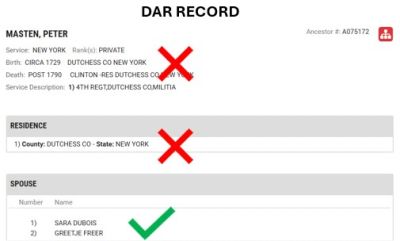
The DAR Record is (mostly) wrong.
Outside of getting his two spouses correct, everything else is wrong - specifically, they have the WRONG Peter Masten, not the one who moved to Pennsylvania. Our Peter Masten left New York in 1770, and we know he's in York County PA around the time the war breaks out. He is not going to head back to NY with a wife and three or four very young children, especially since there probably is still a warrant out for his arrest (because he owes people money).
There are no records of him in the Continental Army, and at 50 - 55 years old, we would not expect there to be.
In 1775, Pennsylvania established the "Association"—a system requiring all able-bodied men to join local military defense units, even the 50-somethings.
- Men who chose not to join, or who were past active fighting age but refused to enroll, were labeled Non-Associators.
- Pennsylvania fiercely penalized Non-Associators by levying a heavy special tax (or fine) on them annually to fund the weapons and supplies of the men who did fight.
However, he was not listed in the Pennsylvania Archives, Third Series, Volume 21, which is a transcript of property and estate tax assessments used to fund the war effort. If you weren't on the main property tax list, you often "slipped through the cracks" of the military fines.
So did he serve? There is no evidence of it, so you will need to decide for yourself.
- Not listed in “Pennsylvania, Revolutionary War Battalions and Militia Index, 1775-1783”
- Not listed in Fold3 (the Peter Masten that is still living in NY is there, though)
- He arrived in Westmoreland County (later Fayette) by 1783; the tax list has a note stating “F. State Omitted”, meaning he was given tax amnesty because he was living on the frontier (perhaps squatting) and owned no land. It likely means he left the Conewago community right as the war was winding down.
Peter settles in Fayette County
Survey of his land

This is the land that Petrus (who is now calling himself Peter) purchased. The Cook house sits directly on the northern border of Peter Masten's original 117-acre survey tract.
Where to find his property now
The blue bubble represents the approximate center of the original 1791 land warrant issued by the Commonwealth of Pennsylvania to Peter Masten. Harmony Acres farm encompasses a good portion of the land today.