Earliest documented appearance in America
When did John arrive in America? This document, written in Dutch in late 1643, shows John (aka Jan) Marston acts as a bondsman for Robert Eden. The text explicitly mentions his involvement with "the English troops" serving the Dutch. This lends credence to him being a soldier hired under the service of Dutch Director General Willem Kieft and establishes him living in the area as early as 1643.
The portion that mentions him is translated: "Brient Nelli and Jan Masten have given security as bondsmen for Robert Eden, stating that his upcoming monthly wages—accruing from his service with the English troops—shall henceforth be collected and deposited in the Fort. It shall remain there to serve as a guarantee and protection against his landlord's claim regarding his housing expenses, and to satisfy the judicial officials or any other interested parties."
Where was he living at the time? The 1645 Patent meant he likely did not own land prior to that. The very court record in the image hints at his living arrangement because he was helping a another English soldier secure money for his landlord to pay for housing expenses. During this period, mercenary soldiers, laborers, and transient Englishmen did not yet own land. As an English soldier in the Dutch service, Marston’s "residence" during these years would have been a military garrison, barracks, or camp.
What was he up to before he started farming? From 1643 - 1645 the settlers who the Dutch West India Company sent over to establish a colony were fighting local Native American tribes (referred to Kieft's War). Kieft hired English soldiers and mercenary forces—notably under English commanders, to fight for the Dutch. John would have been deployed from Manhattan to various active skirmish sites across western Long Island and modern-day Westchester, meaning he was living the life of an active-duty soldier.
In fact, he is listed as "Jan Maste, Soldaet"(Soldier)” in February of 1644, when he appeared at the Reformed Dutch Church in New Amsterdam to act as a baptismal godfather for Jan Pieterzen, the son of a fellow soldier. New Amsterdam Reformed Dutch Church (now known as the Collegiate Church of New York City) was formed in 1628 making it the oldest continuous evangelical church in North America.

Nathaniel Marston (not an relative)
Born in South Lubec, Maine, in 1827, author Nathaniel Washington Marston dedicated much of his adult life to the meticulous documentation of family lineages. This culminated in his defining work, The Marston Genealogy: In Two Parts, which was published in 1888. The book remains a primary reference for historians and descendants of the New England Marston family, documenting the lineage of early immigrants who arrived in Massachusetts and New Hampshire in the 1630s
The existence of Nathaniel in New York at that time is not in question, but he is not an ancestor of Herman Wolf, because the info in this genealogy regarding John Marston of Flushing is INCORRECT.
Y-DNA results show that the New England line of the Marstons is unrelated to the line we are following.

Old "family records" from 1888 produced an error that was propogated about John Marston
"The Marston Genealogy : In Two Parts" is flat out wrong about John Marston and his (imaginary) son Nathaniel. In the 1880s, there was no internet, microfiche, or centralized archive system. Nathan lived in Maine and could not easily travel to New York City to read all of the handwritten, unindexed and untranslated Dutch language books of the Reformed Dutch Church or court records.
- Nathan Washington Marston got some bad info when he stated that John Marston married a woman named Ann Ley or Legg, which we know is not correct. His first and only wife was Dievertje Jans. We have receipts!
- Given how we have proved he was a young adult by 1643 and a soldier in 1644, his birth year would have been in the early 1620's, not 1630 and 1635 as the article states.
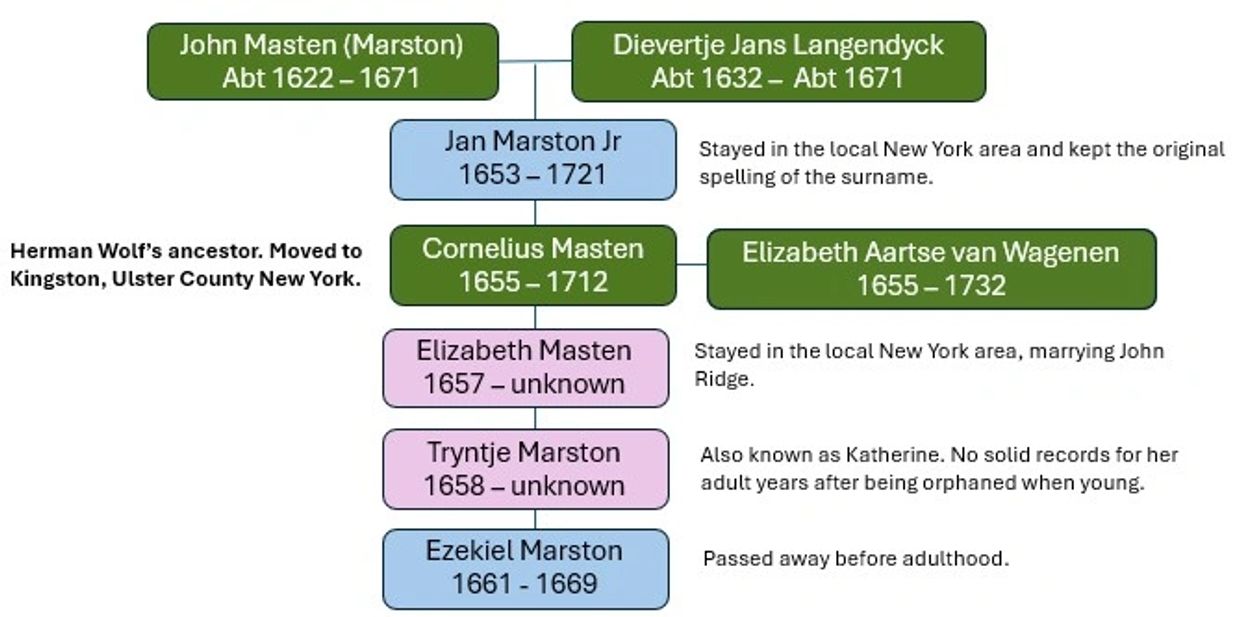
- Marrying a Dutch woman, Cornelis Masten (son of John) adopted the Dutch tradition of naming children, which involves naming the first male after the paternal grandfather and the first female after the paternal grandmother. This totally fits: John and Dieviertje were the first two children of Cornelis and his wife Elizabeth.
- The Marston Y-DNA project proves several UNRELATED lines of Mastens exist, and records show this Nathaniel Marston is not associated with the “New York” line of the Marstons (Mastens) that we’re following.
The article, part of which is shown here, was written by the editor of New York Genealogical and Biological Record, who set out to correct the errors - and he does not mince words about what Nathaniel Washington Marston wrote:
- "not substantiated by any public record therein"
- "he compiler failed to investigate the facts relative to John Marston"
- "the assumption that the copyist made an error in transcription and substituted (inadvertently) the name Cornelius for that of Nathaniel is without foundation for belief"
- "not an iota of evidence to show the parentage of this Nathaniel Marston"
Here is the link to John Reynolds Totten's dopeslap of Nathaniel Washington Marston's work - https://www.newyorkfamilyhistory.org/online-records/nygb-record/566-301/93
Fun fact: the Church where John and Dievertje married still is in existence (the building is not). See the history of the church here: https://www.collegiatechurch.org/
New York Genealogical and Biographical Society. The New York Genealogical and Biographical Record 60, no. 3 (July 1929).

John Marston and the 1645 Flushing Land Patent: Residents strongly promote religious liberty and tolerance in the new land


Marriage of John Masten and Dievertje Jans 10/27/1650
The Groom: Listed in the Dutch records as Jan Masten (an English immigrant, noted as "Uyt Engelandt" meaning "from England").
The Bride: Listed as Dievertje Jans (noted as "Uyt Noordt Holland" meaning "from North Holland").
The Status: They were registered as a j.m. (jong man / young unmarried man) and j.d. (jonge dochter / young unmarried woman), meaning neither had been married before.

John's Homestead (approximation, original plot boundries lost in a fire). This is based on where the kids legal guardian, John Hinchman, lived. He likely would have held between 20 - 40 acres, not necessarily continuous, with access to the Flushing Creek and with a long, ribbon-like shape eastward.


John's Will

Genealogy of the Van Wagenen family from 1650 to 1884. The author, Gerrit H van Wagenen, is related to Elizabeth Aartse van Wagenen, who married John Masten's son, Cornelius.