Upon reaching his legal majority, John Marston's executor John Hinchman handed Cornelis his inheritance: half of the family lands in Flushing. Cornelis was ambitious a realized his small inheritance wouldn't stretch far. He also held a modest cash payout from the estate of his maternal grandfather, Jan Langendyck—a hardworking Manhattan tavern keeper whose house lot had recently been liquidated to settle debts.
Cornelis made a bold, calculated gamble. He sold his inherited shares of the Flushing land, packed his life into chests, pocketed his coin, and likely travelled up the Hudson river on a sloop. At that time, Kingston was a booming, raw frontier trading hub over 90 miles up the Hudson River, where a young man’s starting capital could buy massive opportunity.
Arriving in Kingston as a single, landless outsider, Cornelis had to navigate his first few months carefully. He likely lived in one of the Stockade’s crowded Dutch boarding houses, paying for his meals with his inheritance money. To stretch his coins, he was probably quick to find that he could make a living as a hired hand, helping established farmers clear trees and harvest wheat in the fertile valley. At this time, labor in the Kingston area was in high demand.
However, Cornelis’s ultimate strategy for survival and status relied on a permanent anchor: land. Within his first year in the settlement, found a mate in a young woman named Elizabeth Aertse Van Wagenen.
Elizabeth was an orphan herself. Her father, a prosperous early settler named Aert Jacobsen (van Wagenen), had died years prior, leaving behind a massive, 96-acre farm along the very fertile Esopus Creek. Because the five children had been too young to divide it at the time, the estate had sat waiting. When Cornelis and Elizabeth married around 1676, the legal landscape instantly shifted and Elizabeth and Cornelis found themselves with almost 20 acres of farmland.
Instantly elevated from a landless traveler to a respected "yeoman" farmer, Cornelis built his life. Colonial safety laws required him to build his house and a large barn inside the fortified village—the historic Kingston Stockade District—directly across the road from open fields. In 1689 he signed an oath of allegiance pledging his loyalty to the new (Protestant) British Monarchs, William III and Mary II². For the rest of his days, Cornelis Masten would walk out of his stockade home each morning to cultivate his highly profitable wheat fields along the creek, completely transforming his destiny from a displaced orphan into a founding civic leader of Ulster County.
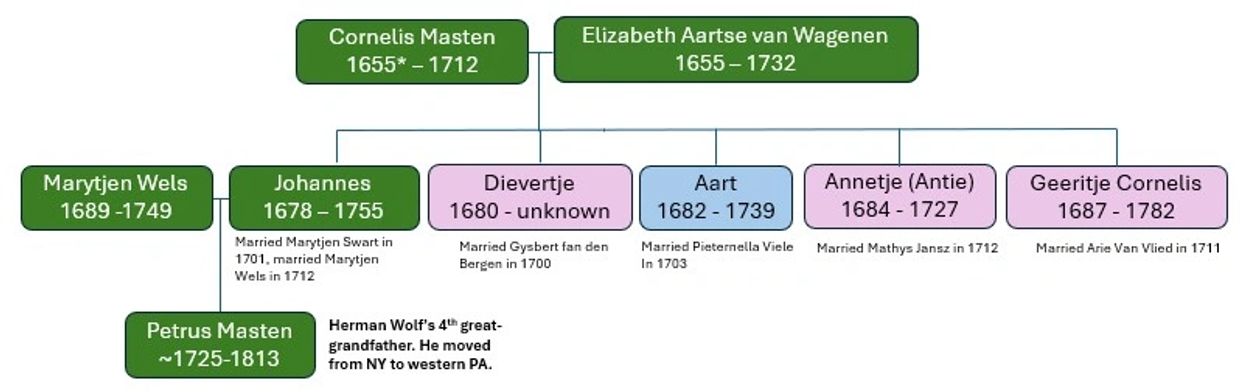
Cornelis and Elizabeth had five children:
- Johannes (1678 – 1755), the 4th great-grandfather of Herman L Wolf
- Dievertje (Deborah) (1680 – ?)
- Aart (1682 – 1739)
- Annetje (Antie) (1684 – 1739)
- Geeritje (1687 – 1782)
Cornelis' grandson, also named Cornelis Masten per Dutch naming conventions —is the 3th great-grandUNCLE of Herman Wolf. Cornelis managed to attach his name to a local piece of real estate: the Cornelis Masten Stone House at 109 Pearl Street, Kingston³. Built between 1725 and 1742, the house, along with the church and the rest of the town, faced a minor setback when the British dropped by on October 16, 1777 to torch the place. The fire took out the roof, but the stone shell survived.
Since Cornelius (the grandson) completely skipped the "marriage and kids" phase of life, he couldn’t leave the house to descendants. Instead, it went to his nephew, Cornelius C. Masten (husband to Catharina van Steenbergen). Eventually, the property was sold to the Consistory of the Old Dutch Church, who turned it into the official parish parsonage.
Now, if you look at certain internet family trees, people love to claim that Cornelius and Elizabeth had another son named "William L. Masten" (1691–1772), who allegedly packed up and moved to Kent County, Delaware. There is not a single shred of colonial evidence in Kingston to prove William ever existed in Kingston. No baptism records, no land deeds, no tax lists, and no wills mention him. Sure, early colonial customs occasionally allowed a youngest son to take a suitcase full of cash and run away from the family estate early. But given the absolute zero-percent trace of primary data in the Hudson Valley area, it is safe to say William of Delaware just crashed the wrong Masten family tree.
On January 30, 1712, Cornelis signed his last will and testament and died that exact same day at age 61. Talk about precise scheduling. He was buried in the Old Dutch Churchyard⁴, but he has no tombstone. He either got the cheap package, a random unmarked fieldstone, or his wooden marker rotted away centuries ago⁵.