
Vital Information
- Birth
- c. 1815, Burgholzhausen, Grand Duchy of Hesse
- Death
- 1853 en route to America
- Spouse
- Maria Katherina Kolass
- Occupation
- Saddler (Sattler)
- Residence
- Burgholzhausen vor der Höhe, Hesse
Biography
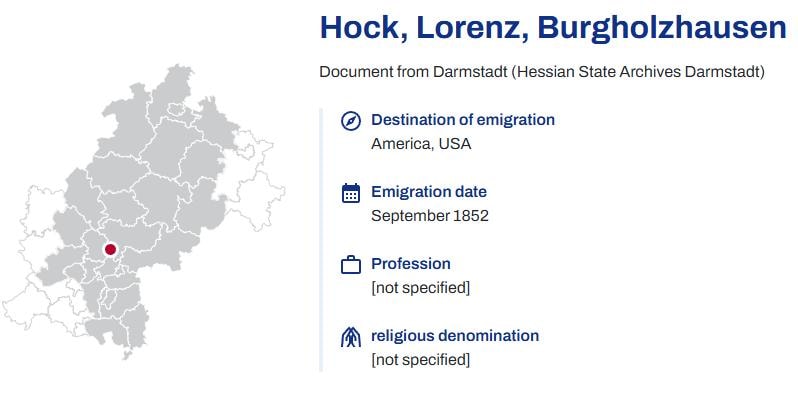
Johann Lorenz Höck was a saddler living in the small village of Burgholzhausen vor der Höhe in the Grand Duchy of Hesse. He and his wife, Maria Katherina Kolass, raised a family there in the mid-nineteenth century. Their daughter Maria — known in America as Mary Hague — emigrated to the United States in 1853 with her parents and older brother, Jacob.
Lorenz Höck's occupation is recorded in his daughter Mary's baptismal record as Sattler — the German word for saddler, a craftsman who made and repaired saddles and other leather goods. This was a skilled trade in rural nineteenth-century Germany, suggesting the family held a modest but respectable position in the village community.
In the years leading up to 1853, families in Burgholzhausen vor der Höhe faced severe economic and social distress. Devastating potato blights and crop failures caused soaring food prices and widespread starvation, while the rise of industrialization crushed the livelihoods of local tradesmen and craftsmen, such as Lorenz. Following the failed democratic Revolutions of 1848, the region was further strained by political oppression, high taxes, and mandatory military conscription. For families looking toward the future, the prospect of affordable, abundant land in America offered a vital escape from an inescapable cycle of poverty. However, families were legally mandated to obtain formal permission from the government before they could depart, in order to protect the local economy and state interests. Officials required proof that an emigrating father had settled all outstanding debts with local merchants and cleared his taxes, ensuring no family could sneak away to America leaving financial liabilities behind. Families were also required to liquidate their properties, pay out any remaining inheritances, and ultimately receive an official certificate of release from their Nassau citizenship, formally granting them the legal right to cross the border and board an emigration ship.
A voyage across the Atlantic on a 19th-century packet ship was a grueling ordeal where hundreds of emigrants were packed into dark, poorly ventilated steerage decks. Sanitation was virtually non-existent, creating a breeding ground for deadly illnesses like cholera, typhus, and dysentery that spread rapidly through the cramped quarters. Passengers braved weeks of violent ocean storms, confined below deck amidst terrifying noise, heavy sea-sickness, and spoiled, meager food rations. These brutal conditions resulted in devastatingly high death rates, forcing grieving families to endure the heartbreak of burying their loved ones at sea before ever reaching America. Lorenz, unforturnately, did not survive the voyage and was buried at sea.