
Ruby Irene Ford Line — Chuck's Ancestors
Benjamin Jones is one of the earliest known ancestors in the Jones line of Chuck's family tree. He appears in records connected to western Pennsylvania and was likely among the settlers who pushed into the frontier in the late 18th and early 19th centuries. The details of his origins — where he was born, who his parents were, and where he came from before Pennsylvania — remain a mystery that family researchers are still working to solve.
Below is what we know of Benjamin's history as an adult. If you are a direct male-line descendant of William Jones Sr (Benjamin's son), a Y-DNA test could be a powerful tool for us to connect with other Jones researchers and potentially identifying Benjamin's parents and his ancestral homeland.
Biography
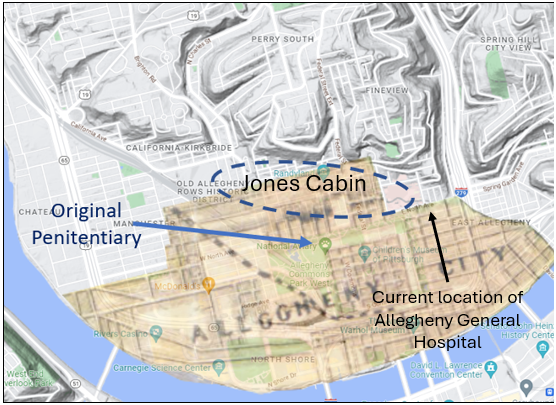
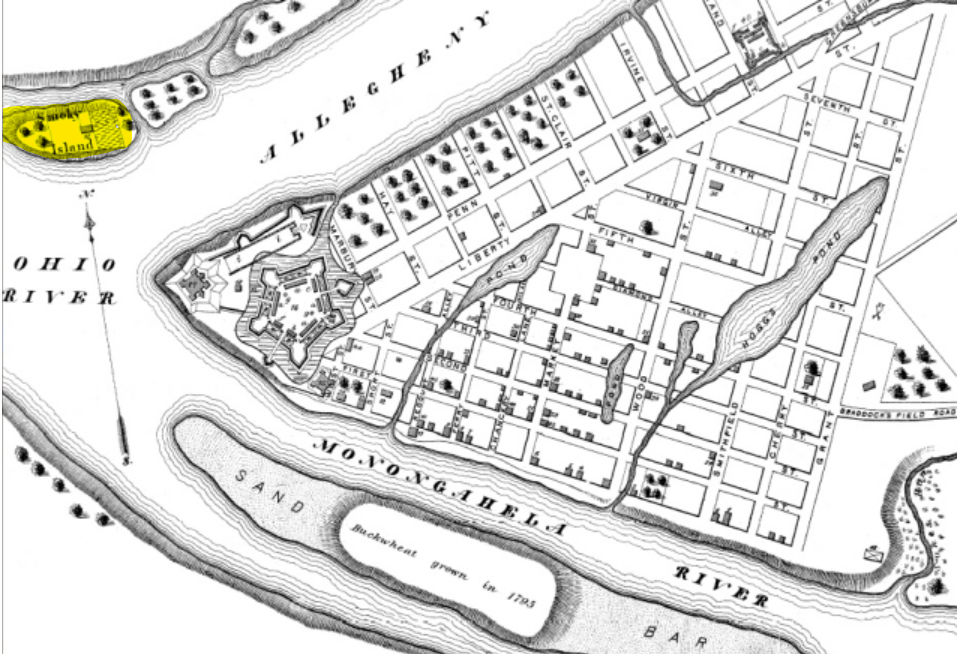
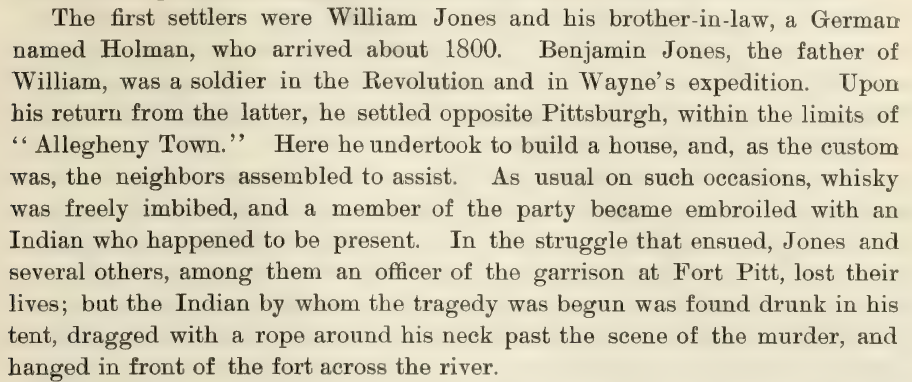
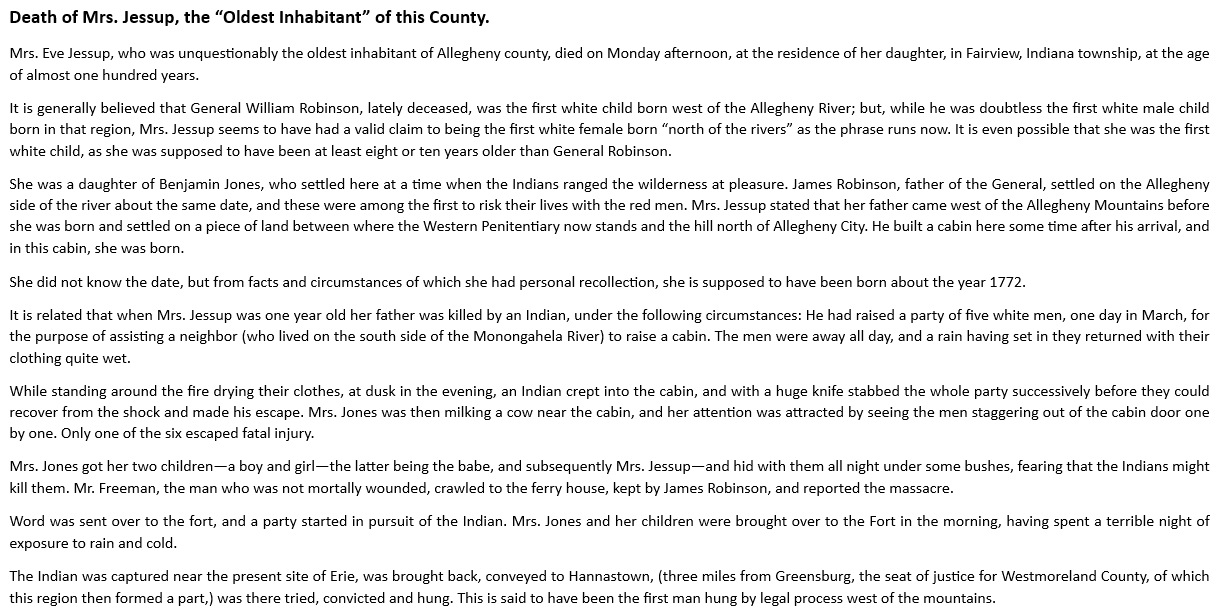
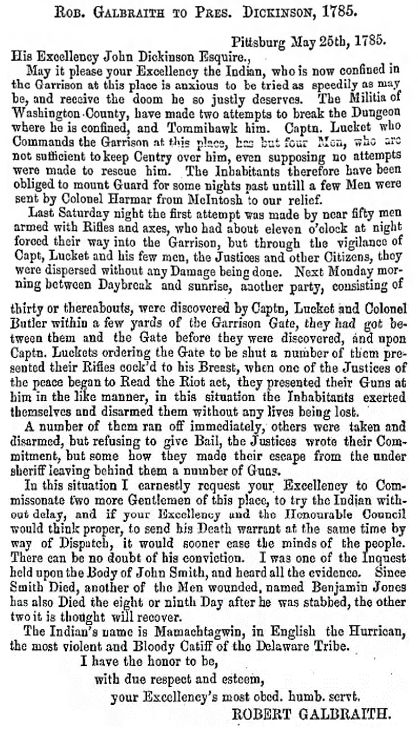
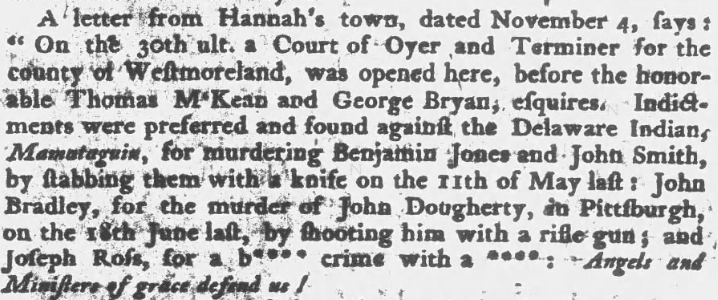
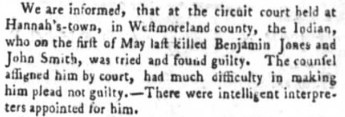
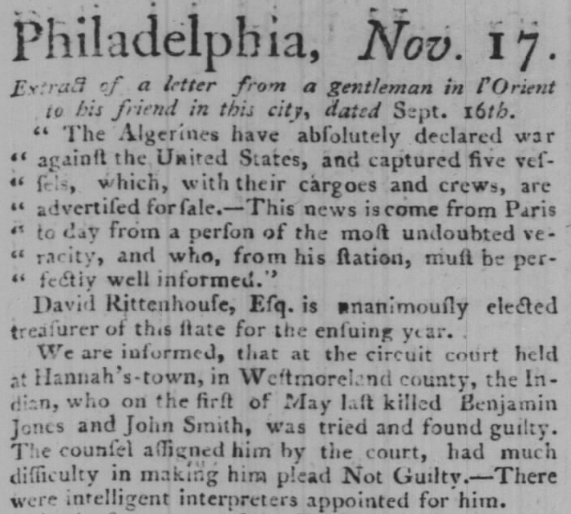
Benjamin Jones (est 1740 – 1785) was married with three children: two sons, including William (~1768 – 1836), and one daughter, Eve (~1783-1868). While the names of his wife and oldest son remain unknown, Eve recalled that her eldest brother was sent to live with another family before their arrival in the Pittsburgh area. Neither he nor the family was ever heard from again, and they were assumed to have been killed. Before the Revolutionary War, Benjamin lived somewhere in central Pennsylvania, though we don't quite know for how long. Eventually, he packed up with his wife and William and headed toward the Pittsburgh area. There, they built a cabin near what would later become Allegheny City—known today as Pittsburgh's North Shore. Eve later recalled that their cabin, where she was born, stood behind "where the Western Penitentiary now stands" and close to "the spring towards the foot of the hill." By matching up 1851 maps of Allegheny City with modern Pittsburgh topography, we can estimate that their home sat right inside the area marked by the dotted line on the map, with the right side of that oval marking where Allegheny General Hospital stands today. We also get some great clues from pension papers filed by Benjamin's son, William, when he was 70. He noted that the family moved to Westmoreland County before the Revolution. Since Westmoreland covered what is now Allegheny County back then, they most likely arrived in the Pittsburgh area sometime between 1773 and the start of the war in 1775. This was truly the frontier.....and most of the civilian population lived in a small village centered near the Monongahela River, stretching roughly between modern-day Market Street, Stanwix Street, and the Boulevard of the Allies in downtown Pittsburgh. It consisted of small wooden homes, trading posts, and small shops. Benjamin likely lived in that community prior to building his log cabin on the North Shore of Pittsburgh, which at the time of his death in 1785 was still relatively uninhabited with perhaps two or three cabins. He was almost certainly a squatter (did not purchase the land he lived on), as many were at the time. There is a reason why people weren't building cabines north of the rivers before the early 1780's. To pay its Revolutionary War veterans (who had been paid in nearly worthless, depreciated paper currency), the Pennsylvania Legislature passed a law on March 12, 1783. This law set aside the entire region north of Pittsburgh as "Depreciation Lands", but it first had to be surveyed and then distributed via a lottery or auctions to the veterans, and that didn't happen until around the time of Benjamin's death in 1785. Before that, the land technically belonged to the Native Americans and it was not purchased from them until 1784 - building a cabin on that reserved tract prior to the Treaty of Fort Stanwix was not only dangerous, but illegal.
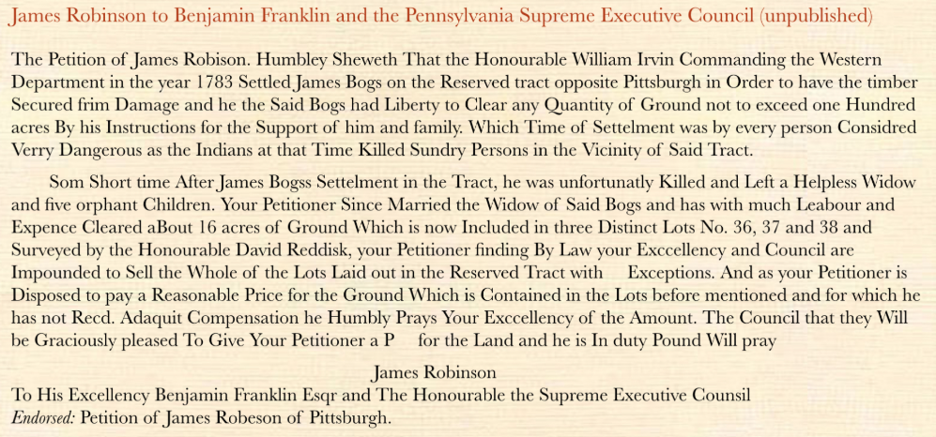
The danger of living on the North Shore prior to 1785 did not deter everyone, but it definitely was not for the faint of heart. James Boggs was the first documented settler on that side of the river and he was killed by a falling tree when trying to clear the land. There was no ferry for someone to obtain help for something like this, or if they were confronted by local Indian Tribes who were upset at people taking their land from them. We don't know exactly where they stayed before that move, but William's papers mention he was born in "Little York" (which we know today as York, PA). He also shared that they lived near Turtle Creek in Westmoreland County for three years. They likely settled right near the mouth of the creek, close to Frazier's trading post and a handful of other early pioneers.
We don't know exactly where they stayed before that move, but William's papers mention he was born in "Little York" (which we know today as York, PA). He also shared that they lived near Turtle Creek in Westmoreland County for three years. They likely settled right near the mouth of the creek, close to Frazier's trading post and a handful of other early pioneers.
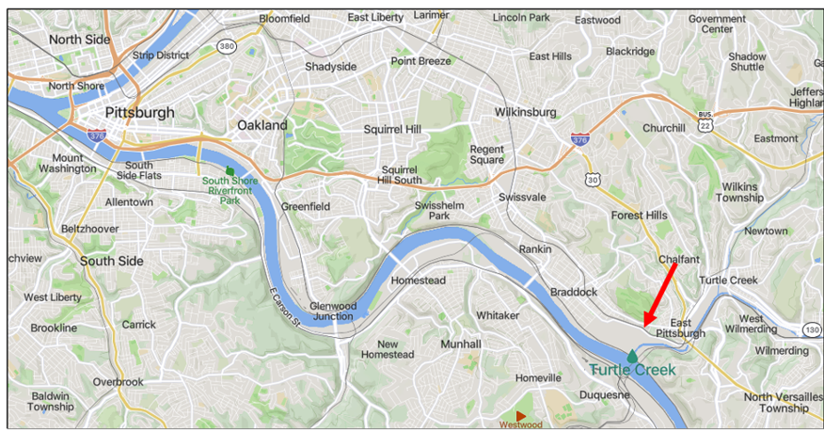
Eve always said her father "came west of the Allegheny mountains" before she was born. The timeline for that move fits perfectly with local history: William Penn's family purchased the Westmoreland territory from the Six Nations in 1768, and the land opened to settlers in April 1769. This means the family likely moved to Turtle Creek between 1769 and 1771. Following the timeline in the pension papers, they wrapped up their journey and arrived in the Pittsburgh area around 1773, just a couple of years before the Revolutionary War broke out in April 1775.
Revolutionary War
While Benjamin was absolutely a Revolutionary War veteran—and is officially recognized by two of Eve Jones Jessup's descendants in the Daughters of the American Revolution (DAR) database—a lot of the information on his record is actually incorrect or unverified. If we look closely at the data, a few major red flags stand out:
- The wrong death date: The database lists his death as 1800, but we know for a fact he passed away in 1785.
- A timeline conflict: His birth year is listed as 1760. This is off by at least 16+ years, considering his second son, William, stated he was age 70 when he filled out his pension documents in 1834, making his second son's birthdate around 1764. Benjamin was likely born in the early 1740's.
- The Welsh connection: The records claim he came from Wales. While that might be true, we don't have proof. The furthest back we can trace him is York County, Pennsylvania, where William was born.
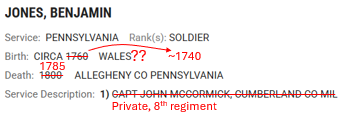
His military service description is also likely inaccurate. The DAR lists him serving under Captain John McCormick in the Cumberland County Militia. However, as we saw in William's pension documents, the family had already moved to the Pittsburgh area before the war even started. Because of this, Benjamin almost certainly would have served in the 8th Regiment, which recruited heavily from Western Pennsylvania.
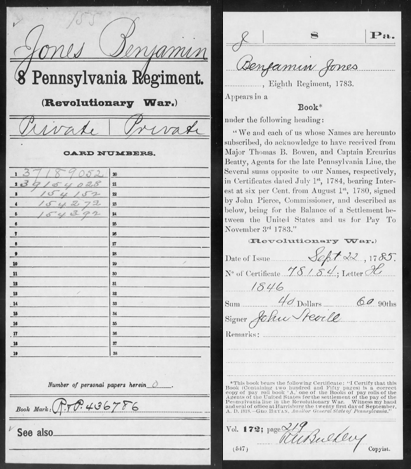
You might notice that his final military paycheck was issued just after he died. This timing doesn't disprove his time in the 8th Regiment, especially when you look at who signed it: John Neville. Neville was the captain of an independent company sent to defend Fort Pitt back in 1775, and he went on to become the namesake of Pittsburgh's Neville Island, where he lived after the war. In reality, during the 18th century, if a soldier died or was killed after the war but before their final back-pay accounts were settled, the government did not cancel the debt. They still issued the certificate posthumously under the deceased soldier's name so it could be passed into his estate. (Note: The document shown is one of a few paystubs from the National Archives (NARA), specifically the Compiled Service Records of Soldiers Who Served in the American Army During the Revolutionary War, record group 93, publication M881).
Eve Jones Jessup
Text of interview with EVA JONES JESSUP: A Scrap of History The First White Child born West of the Allegheny River The First Settlement of Allegheny City and First Murder and Execution. Pittsburgh Weekly Gazette Pittsburgh, Pennsylvania
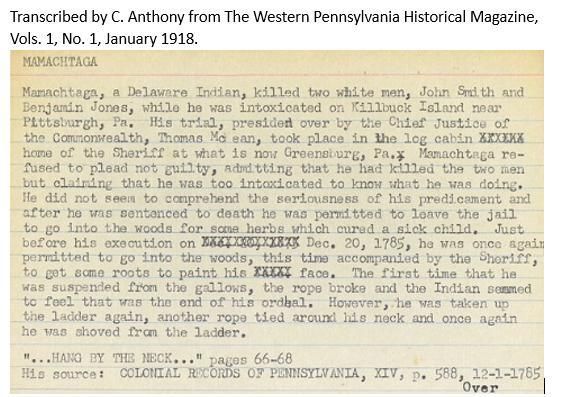
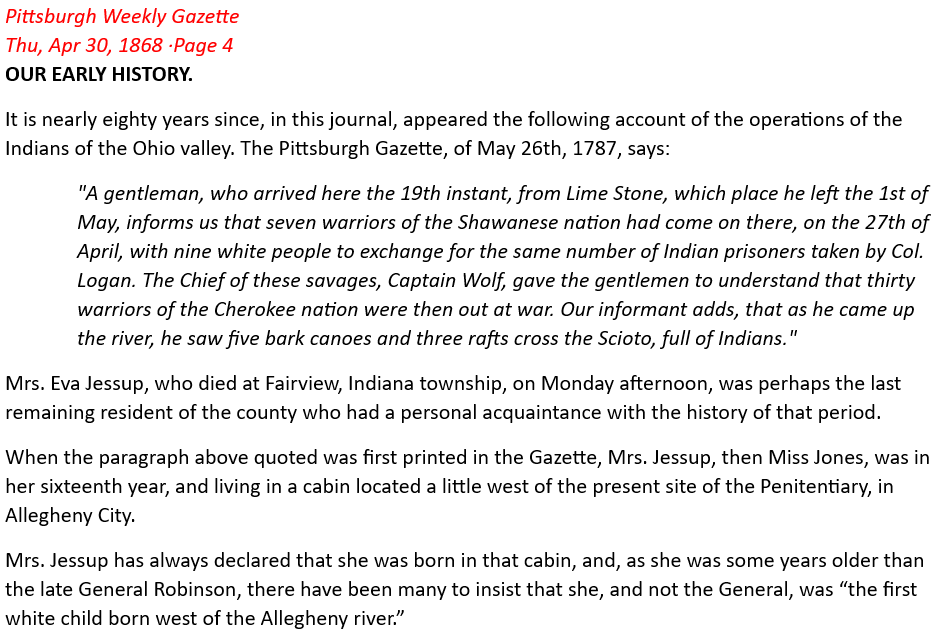
10 Apr 1868, Friday Page 7 In the Pittsburgh Quarterly Magazine, April number, there hits been commenced a history of Pittsburgh, from the easy and graceful pen of J. Trainer King, Esq. This new history will be devoted almost exclusively to topics particularly bearing on the mechanical, professional and educational advancement, and growth of the city, rather than its military traditions. We take the liberty of publishing the following interesting extract from the first part of the history, regarding the early settlement of Allegheny, which will give an idea of the generally interesting character of the work, which will doubtless prove, when completed, the most complete and fullest history of any city ever published: even when the Indians still had undisputed possession of all the lands west of the Allegheny river, the friendship they professed for the English after the French had vacated Fort Duquesne induced at least two families to risk their lives in their midst beyond the Allegheny those of James Robinson, father of the late General William Robinson, and Benjamin Jones. Which of these families first ventured their "little all'' amongst the red men in their own land, is not positively known. It had been claimed that General William Robinson wan the first white child born west of the Allegheny River; there is, however, a doubt about this, although that he- was the first white male child is unquestioned. The author, in researching for information endeavored to trace out all the very old settlers living within reach, note their recollections and obtain all the old letters and documents they had, yet unpublished. From General Robinson he had the promise of all the information he had at his disposal, but death intervened unexpectedly, and he was thus deprived of notes from him to compare with those gotten from others. Hearing that the first white woman born west of the Allegheny was still living, and could be found at Fairview, in the person of one Mrs. Jessup, a daughter of Benjamin Jones above referred to, he visited that place and found a very old lady confined to her bed in a room of her daughter's house, on the bluff overlooking Fairview. Although bed-ridden for some live years and emaciated almost to a skeleton, her mind is still vigorous, and her memory, except for dates, quite clear. She stated that her father, Benjamin Jones, came over the mountain before she was born, bringing with him her mother and one son, then a small boy. Another older son had been sent with another family, starting about the same time or previous, but neither the boy nor the family were ever heard of again, and it is supposed they were all killed by the Indians. Sometime after her father arrived here, he located on an improved a spot of ground in back of where the Western Penitentiary now stands. The cabin was built near "the spring towards the foot of the hill", and there she was born. At what date her father made the settlement she does not know but judging from a series of circumstances connecting "this with that," it must have been as early as 1770. Mrs. Jessup says that when she was about one year old, and during the month of March, her father with five other white men crossed the Monongahela River one day to assist a friend in raising a cabin. The day was exceedingly wet and cold, and when the men returned in the evening about dark they were drenched to the skin. A good wood fire "was built up" and the men all stood around it to dry their clothes. Mrs. Jones had gone out and was milking a cow under the shelter of an apple tree that stood near the cabin. While thus occupied she saw one of the men stagger out of the door and fall; she thought it a little singular, as she had not noticed that any of them were drunk: but her reflections were cut short by the appearance of another who likewise staggered and fell, then another, and still another, until the whole six lay in a heap. The truth had ere this flashed upon her, but prudence bade her keep perfectly still. When all seemed quiet, with fear and trembling, she noiselessly approached the cabin, secured the children who were left undisturbed in their humble bed in one corner, and fled into the darkness, lest she and they should be the next victims. The rain was still pouring down in torrents, and to use Mrs. Jessup's own language, the "night was powerful dark; trembling in every limb, not only from fear, but with cold, she passed the night under some "paw-paw" bushes, using sometimes her own body and sometimes making the boy use his to protect the child from the storm; and had not this precaution been taken, Mrs. Jessup, who was that child of nearly a hundred years ago, might not be living to-day to repeat her mother's account of that fearful night. The long sleepless hours that intervened before the morning, which might bring her relief or consign her to a similar or perhaps worse fate than her husband had met, was an age of horrible forebodings. As it afterwards transpired, the six men - bad been stabbed by an Indian who had stealthily crept up behind and done his work with such precision and dispatch that there was scarcely an out-cry. One of the men, however, by the name of William Freeman, escaped fatal injury; the other five, including Mr. Jones, died, it is supposed, instantly. Freeman after a time recovered his senses, and with his remaining strength crawled to the Ferry House kept by James Robinson. He stated the occurrence to Mr. Robinson, who immediately sent word to Fort Pitt, from whence a party of men was sent in pursuit of the assassin. In the morning Mrs. Jones and her children were brought over to the Fort and properly provided for. The pursuing party followed the Indian's trail for several days, and finally succeeded in making him prisoner at a point on Lake Erie, near where the city of Erie is now situated. His captors reached the Fort in safety with their prisoner, and it was at first determined that the boy Jones should shoot him to avenge the death of his father, but wiser counsel prevailed, and he was taken to Hanna's Town, placed in the county jail and afterwards tried, found guilty and executed the first man hung west of the mountains by order of law. Mrs. Jessup could not remember the Indian's name, and as the records of the court were all destroyed when the town was sacked by the Indians, this and the precise date of the hanging are ' likely to remain shrouded in mystery. As Mrs. Jessup was a year old at the time of the murder of her father, the inference Is that she was born some years before General Robinson, unless his age was greater ' than computed. Judging from these and many other circumstances with which I have been made acquainted, such as the ages of her children, that of her brother, the fact of the apple-trees being large enough for shelter at the time of the killing, I feel justified In saying that Benjamin Jones must have settled on that side or the river as early as 1770; that Mrs. Jessup at least a nonagenarian, (although It is claimed that she is a centenarian), and was the first white child born west of the Allegheny river. Is it not remarkable that the very first white person born west of the Allegheny to still living, when tens, perhaps hundreds of thousands, since born west of this boundary have paid the penalty entailed on man.
Additional Notes
Images
Additional Reading
First Indian Tried for Murder in the US : The Trial of Mamachtaga, Westmoreland Co., PA, 1785 (YouTube video)